 KnowThis
Key Takeaways
Key Takeaways
- 1The "hidden job market" describes roles filled through referrals, internal moves, or direct outreach — it isn't a secret listing anywhere a job seeker could find and browse.
- 2Employers favor these routes because a known, vouched-for candidate reduces hiring risk and screening cost compared to the open applicant pool, not because the role is being deliberately concealed.
- 3Some roles are posted publicly even after an internal or referred candidate is the likely pick, often to satisfy internal policy or documentation practices — the posting existing doesn't guarantee the process is genuinely open.
The concept
Once the risk-reduction mechanism is visible, it explains why networking outreach and referrals consistently outperform cold applications in practice — not because of luck, but because they solve the employer's trust problem more cheaply.
Why do employee referrals often move faster through a hiring process than an unreferred application for the same role?
Worked examples
Example 1: A role filled by internal promotion before it's ever posted (baseline case)
A team lead position opens up when the current lead moves to a new department. The manager already knows a strong internal candidate on the team who's expressed interest in growing into the role. After a short internal conversation and approval, that person is promoted — the role is never posted publicly at all, because the employer had no need to look further once a known, trusted internal option existed.
Example 2: A role posted publicly even though an internal candidate is likely (edge case / variation)
A job seeker applies to a publicly posted role, unaware the hiring manager already has a strong internal candidate in mind. What does this situation actually reflect?
Example 3: Networking into a role before it's advertised (real-world / applied case)
A job seeker requests a short informational interview with someone working in their target field, mainly to learn more about the industry, not to ask for a job directly. Months later, that contact's team has an opening and remembers the earlier conversation, reaching out directly before the role is ever posted publicly. The job seeker is now being considered through direct outreach — the referral/network path — rather than competing against however many applicants a public posting would eventually draw.
Why can an informational interview months earlier lead to being contacted directly about a role that's never publicly posted?
How it works (visual)
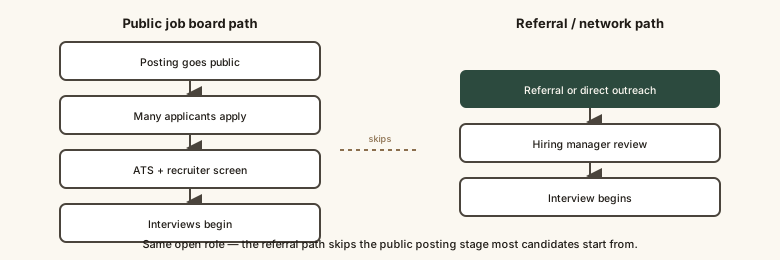
Both paths can lead to the same offer — the referral path just enters the process further along, having already solved the trust problem a public posting has to solve through screening.
Common mistakes
Common Mistakes
Relying almost entirely on public job board applications and treating networking as optional extra credit.
→ Split job search effort between both paths — public applications reach postings that exist, while direct outreach and referrals reach roles that may never be posted at all.
Assuming every publicly posted role is a genuinely open, first-come competition.
→ Apply anyway when a role fits, but don't be discouraged if a public application goes quiet — some postings run alongside an internal or referred candidate already in motion.
Treating an informational interview as a disguised job pitch instead of a genuine conversation.
→ Keep the ask focused on learning about the role or field — a pushy pitch tends to close the door, while a genuine conversation is what tends to get remembered later when an opening appears.
Common misconception
“The hidden job market means most good jobs are deliberately kept secret from outside applicants and you need insider access to even hear about them.”
It isn't deliberate concealment — it's a byproduct of how hiring risk works. Employers default to known, trusted candidates when one is available because it's cheaper and lower-risk than screening an open pool, not because they're hiding roles from outsiders. Anyone can build the same kind of trusted connection through networking, informational interviews, or direct outreach — it isn't reserved for people who already happen to know someone.
What to do next
What to do next
- Alongside public applications, identify a handful of people in your target field or companies and request brief, genuine informational conversations.
- Let current or former colleagues know specifically what kind of role you're looking for — a vague "let me know if you hear of anything" is much easier to forget than a specific ask.
- Don't treat a quiet public application as proof you're unqualified — some roles run alongside an internal or referred candidate from the start.
- Read How Recruiters Actually Screen Candidates next to see how a referred candidate moves through the process differently than a cold applicant.