 KnowThis
Key Takeaways
Key Takeaways
- 1Behavioral questions ask about real past experience specifically because past behavior predicts future behavior more reliably than a hypothetical or a general self-description.
- 2The underlying goal is testing for job-relevant competencies (judgment, communication, problem-solving) through concrete evidence, not just curiosity about what happened.
- 3A hypothetical answer ('I would probably...') is easier to fake convincingly than a specific, checkable account of something that actually happened.
The concept
Once the reasoning is visible — real evidence beats self-report — the practical implication for a candidate is direct: an answer grounded in a specific true event does more work than an answer grounded in a confident general claim.
Why do interviewers generally trust an answer describing a specific past event more than an answer describing how a candidate 'usually' handles a situation?
Worked examples
Example 1: A behavioral question testing communication under pressure (baseline case)
An interviewer asks, "Tell me about a time you had to explain a complex problem to someone without technical background." This is a behavioral question — it asks for a specific instance, not a general opinion on the candidate's communication skills. The answer that follows gives the interviewer real evidence: which situation, what the candidate actually said, and how the listener responded.
Example 2: The same competency asked as a hypothetical instead (edge case / variation)
What's the key limitation of a hypothetical question ('How would you handle X?') compared to a behavioral one ('Tell me about a time you handled X')?
Example 3: A structured interview panel scoring multiple candidates consistently (real-world / applied case)
A hiring team interviewing five candidates for the same role asks each of them the identical set of behavioral questions and scores each answer against the same rubric (looking for evidence of specific competencies like judgment or collaboration in each Action step). Because every candidate answers the same specific-example-based questions, the panel can compare responses on a like-for-like basis — something a freewheeling, unstructured conversation with each candidate wouldn't reliably support, since different conversations would surface completely different, non-comparable information.
Why does asking every candidate the same behavioral questions (rather than having an open-ended conversation with each) help a hiring panel make a fairer comparison?
How it works (visual)
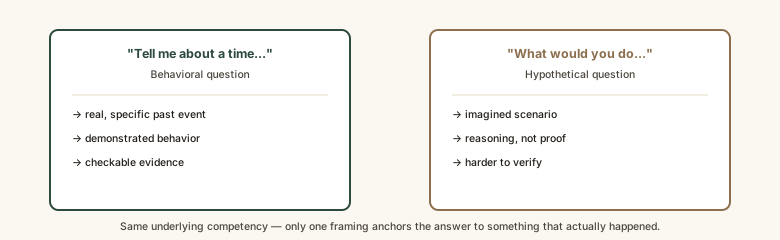
Both question types have a place in an interview, but only one of them produces evidence an interviewer can actually check against something that happened.
Common mistakes
Common Mistakes
Answering a behavioral question with a general statement instead of a specific real example.
→ Recognize the 'tell me about a time' framing as a request for one specific story, and answer accordingly — even if it feels natural to generalize.
Assuming behavioral questions are trying to catch you doing something wrong.
→ Understand the actual goal is evidence of a job-relevant competency, including how you handled a genuine setback or mistake — an honest, reflective story often lands well.
Preparing only success stories and having nothing ready for questions about failure or conflict.
→ Prepare a small set of stories covering different competencies, including at least one genuine setback and what was learned from it.
Common misconception
“Behavioral interview questions are just a formality — any confident-sounding answer will satisfy the interviewer.”
Interviewers trained in structured behavioral interviewing are specifically listening for concrete, checkable detail — a specific situation, a specific personal action, a specific result — not just confident delivery. A vague or generalized answer, however smoothly delivered, tends to score lower on a structured rubric than a shorter but genuinely specific one, because the format exists precisely to filter out unverifiable self-description.
What to do next
What to do next
- Before an interview, prepare specific real stories for common competency areas (conflict, failure, leadership, problem-solving), not general statements about your strengths.
- Practice noticing whether a question is asking for a real past event ('tell me about a time') versus a hypothetical ('what would you do') and answer accordingly.
- Include at least one honest story about a setback or mistake, since structured interviewers value genuine reflection over an unbroken string of successes.
- Read The STAR Method Explained next to structure those specific stories clearly.