 KnowThis
Key Takeaways
Key Takeaways
- 1STAR stands for Situation, Task, Action, Result — a four-part structure that forces an interview answer to describe one specific real event, not a general claim.
- 2The Action step is the part interviewers care about most, because it's the only piece of the answer that isolates what the candidate personally did.
- 3A STAR answer without a concrete Result still leaves the interviewer unable to judge whether the action actually worked — Result is not optional.
The concept
Once the four parts are separated, the practical value becomes clear: an interviewer can only evaluate what they can actually check against something concrete, and STAR is what turns a vague claim into something checkable.
Why is the STAR method's structure more persuasive to an interviewer than a general statement like 'I'm good at problem-solving'?
Worked examples
Example 1: Answering "tell me about a time you missed a deadline" (baseline case)
Situation: A candidate's team was building a client report due in one week, and a key data source failed two days before the deadline. Task: They needed to still deliver an accurate report on time. Action: They flagged the issue to their manager immediately, found an alternate data source, and worked with a colleague to manually cross-check the numbers overnight. Result: The report was delivered on time with a documented note about the substituted data source, and the client never noticed a gap in quality. Each part is one or two sentences — specific, not padded.
Example 2: An answer that skips the Action step entirely (edge case / variation)
A candidate's answer mentions a difficult situation and a good outcome, but says only 'we figured it out as a team.' What's missing from a STAR perspective?
Example 3: Adapting one story for multiple different questions (real-world / applied case)
A candidate prepares one strong story about resolving a major vendor issue before an interview. In the actual interview, they're asked three different questions — about problem-solving, about conflict, and about working under pressure. Because they understand the STAR structure rather than memorizing a fixed script, they can pull the same underlying Situation and Task but shift which part of the Action they emphasize (the negotiation for the conflict question, the timeline management for the pressure question) — reusing one well-prepared example flexibly rather than needing a completely separate story for each possible question.
Why does understanding the STAR structure (rather than memorizing a fixed script) help a candidate answer multiple different interview questions?
How it works (visual)
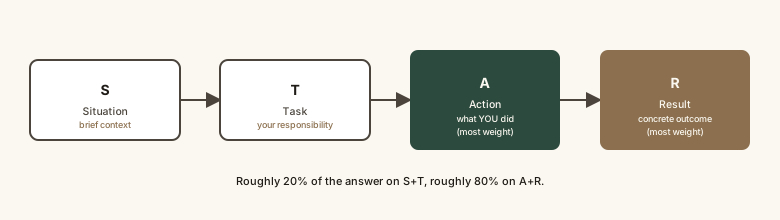
The order matters because each part sets up the next — Result only lands as evidence if the specific Action that produced it was already made clear.
Common mistakes
Common Mistakes
Spending most of the answer describing the Situation and Task, running out of time before Action and Result.
→ Keep Situation and Task brief (roughly 20% combined) and spend most of the answer on Action and Result.
Describing what 'the team' did instead of what the candidate personally did.
→ Use 'I' statements for the Action step specifically — the interviewer is evaluating individual judgment and behavior.
Ending the story without stating a clear Result.
→ Always close with a specific outcome — even a Result that wasn't a full success is more useful than no stated result at all.
Common misconception
“STAR answers need to describe a perfect success story to be effective.”
Interviewers are often more interested in the reasoning and judgment shown in the Action step than in a flawless outcome. A STAR answer describing a genuine mistake, what was learned, and how it was corrected can be just as effective as a clean success story — what matters is that the Situation, Task, Action, and Result are specific and honest, not that the ending is uniformly positive.
What to do next
What to do next
- Before an interview, prepare 3–5 real stories from past experience that can flex to cover common behavioral themes (conflict, failure, leadership, deadlines).
- For each story, write out the Situation, Task, Action, and Result separately, keeping Situation and Task brief.
- Practice saying each Action step using 'I' rather than 'we' to isolate your own personal contribution.
- Read Why Companies Ask Behavioral Interview Questions next to understand what the interviewer is actually listening for.