 KnowThis
Key Takeaways
Key Takeaways
- 1A chronological resume organizes by date, showing a clear career progression — it's the format most recruiters expect and can scan fastest.
- 2A functional resume organizes by skill instead of date, which mainly helps when the timeline itself (gaps, unrelated jobs, career changes) would work against the candidate.
- 3A functional format can read as evasive to an experienced recruiter, because it's most often chosen specifically to de-emphasize a timeline problem — so it should be a deliberate choice, not a default preference.
The concept
Once the tradeoff is visible — functional format trades timeline visibility for skill emphasis, at the cost of looking evasive to an experienced reader — the choice becomes about whether that trade genuinely helps your specific situation.
Why do most career resources recommend the chronological format as the default choice?
Worked examples
Example 1: A steady career progression (baseline case)
A candidate has worked in the same field for ten years, moving from analyst to senior analyst to team lead at two companies, with no gaps. A chronological resume shows this progression clearly and favorably — each entry demonstrates increasing responsibility, and the dates work in the candidate's favor rather than against them. There's no reason to obscure a timeline this strong.
Example 2: A candidate with a genuine multi-year employment gap (edge case / variation)
A candidate has a genuine multi-year employment gap and wants to avoid it being the first thing a recruiter notices. What's generally the better approach?
Example 3: A career changer with transferable but not directly relevant job titles (real-world / applied case)
A candidate moving from retail management into human resources has ten years of job titles that don't say "HR" anywhere, but genuinely involved hiring, training, and conflict resolution. A functional resume grouping their experience under headings like "Hiring & Onboarding" and "Employee Relations" makes the transferable skills immediately visible to a recruiter who might otherwise skim past unfamiliar retail job titles in a chronological list — this is one of the clearer legitimate cases for the functional format, since the issue isn't a gap but title mismatch.
Which situation is the strongest legitimate case for using a functional resume format?
How it works (visual)
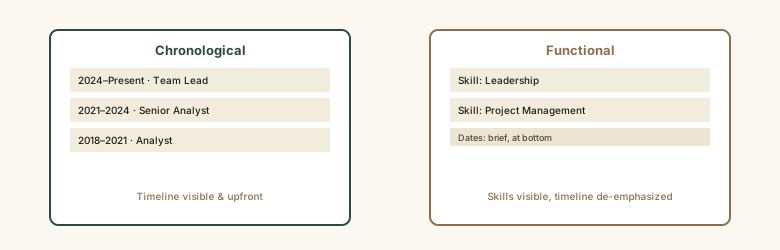
Neither structure is objectively better — each makes a different piece of information easier to see, at the cost of making something else harder to see.
Common mistakes
Common Mistakes
Choosing a functional format just because it feels more 'organized' or modern-looking.
→ Default to chronological unless a genuine timeline issue (gap, mismatch, pivot) gives a specific reason to deviate.
Using a fully functional format to hide a gap, not realizing recruiters recognize the pattern.
→ Consider a hybrid format instead — it surfaces strengths first without omitting the timeline outright.
Assuming format alone can fix a real gap in relevant experience.
→ Format changes emphasis, not substance — no layout choice substitutes for genuinely relevant experience or an honest explanation.
Common misconception
“A functional resume is a safer, more discreet way to handle any resume weakness.”
It's the opposite in many cases — because functional resumes are so strongly associated with hiding an employment gap or a lack of relevant recent experience, an experienced recruiter often reads the format choice itself as a signal to look closer. A hybrid format, or an honestly framed chronological resume, often builds more trust than a format explicitly built to obscure the timeline.
What to do next
What to do next
- Default to a chronological resume unless you have a specific, identifiable timeline issue.
- If you have a gap or a career pivot, try a hybrid format (skills summary + full chronological history) before going fully functional.
- If you do have a gap, consider addressing it briefly and honestly rather than trying to hide it through format alone.
- Read How to Quantify Achievements on a Resume next to strengthen whichever format you choose.