 KnowThis
Key Takeaways
Key Takeaways
- 1A cover letter's job is to explain why specific experience fits a specific role — the resume already lists what happened, so the letter should say why it matters here.
- 2A letter that just restates resume bullets in paragraph form provides no new information and wastes the one section an employer would actually read for reasoning.
- 3The strongest cover letters name the employer's actual need and connect one or two concrete pieces of experience directly to it, rather than summarizing an entire career.
The concept
Once the letter's job is separated from the resume's, the practical test becomes simple: does this sentence explain a connection, or does it just restate a fact the resume already states?
What is the core function a cover letter serves that a resume alone doesn't?
Worked examples
Example 1: Rewriting a restated bullet into an actual connection (baseline case)
A draft cover letter reads: "I managed a team of 8 and increased department efficiency by 20%." This is just a resume bullet in sentence form — it adds nothing. The rewritten version reads: "Your posting mentions scaling the support team through this year's growth — when I managed a team of 8 through a similar 40% headcount increase, the 20% efficiency gain came specifically from restructuring how tickets were triaged, which is the same bottleneck this role seems to be solving for." The facts are identical; only the second version explains why they matter to this employer.
Example 2: A career changer with no directly matching job title (edge case / variation)
Why is a cover letter especially valuable for a candidate changing careers into a field where their resume's job titles don't directly match?
Example 3: Comparing a generic letter to a targeted one for the same job (real-world / applied case)
Two equally qualified candidates apply for the same marketing role. One sends a letter that could be sent to any marketing job at any company, with only the company name changed. The other names the employer's recent product launch, explains a specific relevant campaign they ran, and states directly how that experience applies to the challenge the posting describes. Even with identical resumes, a hiring manager reading both letters gets clear evidence of genuine, specific interest from only one of them — and that evidence, not the writing quality itself, is what the letter is for.
Two candidates have identical resumes for the same role. One submits a generic letter, the other a targeted one naming the employer's specific need. What does the targeted letter primarily demonstrate that the generic one doesn't?
How it works (visual)
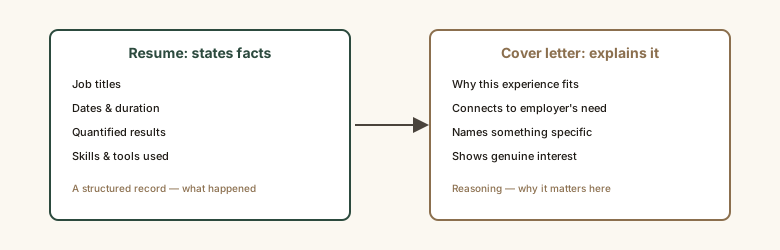
The two documents work together specifically because they don't duplicate each other — one is the record, the other is the reasoning layered on top of it.
Common mistakes
Common Mistakes
Restating resume bullets in full sentences instead of explaining why they matter for this role.
→ For every sentence, ask whether it adds a connection or reasoning the resume doesn't already provide — cut anything that's a pure restatement.
Sending the same generic letter to every employer with only the company name swapped.
→ Name at least one specific, real detail about the employer's actual need, product, or challenge that the letter's reasoning connects to.
Trying to summarize an entire career in one cover letter.
→ Focus on one or two specific pieces of experience that most directly connect to this particular role's need.
Common misconception
“A cover letter is just a formality most hiring managers skip anyway, so the content barely matters.”
Whether a given hiring manager reads every letter varies, but that doesn't make the content interchangeable when they do — a generic letter provides zero signal, while a specific, well-reasoned one is often the only place in an application where genuine interest and non-obvious connections get to be stated directly. Treating it as pure formality means giving up the one section designed to do something a resume structurally can't.
What to do next
What to do next
- Read the job posting and identify one specific need or challenge it describes, not just the list of requirements.
- Pick one or two pieces of your own experience that most directly connect to that specific need.
- Go through your draft and remove any sentence that just restates a resume bullet without adding reasoning.
- Read The STAR Method Explained next to structure the specific experience you connect in the letter.