 KnowThis
Key Takeaways
Key Takeaways
- 1A quantified achievement states a measurable result, not just a task — the difference between 'managed a budget' and 'managed a $2 million annual budget with zero overspend.'
- 2Numbers work because they give a reviewer a scale to judge impact — without one, two very different levels of performance can read identically on the page.
- 3When a true before/after result isn't available, a scope number (team size, volume, frequency) still adds a concrete scale that a plain duty statement lacks.
The concept
Once the mechanism is clear — a number gives the reader a scale a duty statement can't — the practical skill becomes finding the real number behind work that was never tracked with a metric in mind.
Why does adding a number to a resume bullet point make it more persuasive than a duty description alone?
Worked examples
Example 1: Turning a sales duty into a measured result (baseline case)
A candidate's draft bullet reads "Responsible for regional sales." Looking back at actual figures, they find that regional sales were $1.2 million the year before they took over the territory and $1.6 million by the end of their first full year. The rewritten bullet becomes: "Grew regional sales from $1.2M to $1.6M (33% increase) over one year." The task is identical — the visibility of the result is completely different.
Example 2: Quantifying a role with no obvious before/after metric (edge case / variation)
A candidate's role has no obvious sales figure, revenue number, or percentage to report. What's the best way to still quantify the achievement?
Example 3: Comparing two candidates with identical duties, different bullets (real-world / applied case)
Two candidates for the same customer support role both spent a year resolving tickets. Candidate A writes "Resolved customer support tickets." Candidate B writes "Resolved an average of 45 support tickets per week with a 96% customer satisfaction rating, reducing average response time from 8 hours to 3." A hiring manager reviewing both resumes has no way to compare Candidate A's actual performance level, while Candidate B's numbers make the scale and quality of their work immediately legible — even though both candidates may have done comparably strong work.
Two candidates did comparably strong work in similar roles, but only one quantified their resume bullets. What's the most likely practical effect in a hiring review?
How it works (visual)
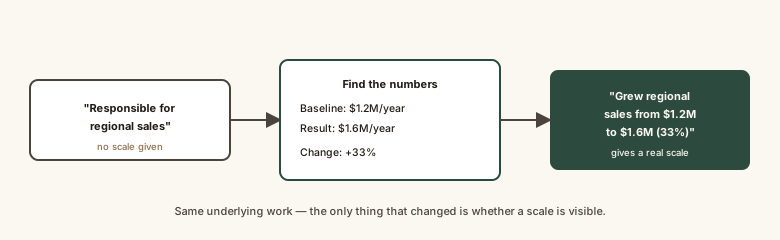
The transformation is mechanical once the baseline and result are found — the writing skill is finding those two numbers, not the sentence structure itself.
Common mistakes
Common Mistakes
Estimating or rounding up a number without a real basis for it, just to have a metric.
→ Use only numbers you can explain and stand behind in an interview — an indefensible number is worse than none at all.
Quantifying effort instead of outcome (e.g. 'worked 50 hours a week').
→ Focus the number on the result the effort produced, not the amount of time or effort spent — outcome is what a reviewer actually cares about.
Assuming a role has no quantifiable achievements at all and leaving every bullet vague.
→ Look for scope indicators (volume, team size, frequency, budget) even when a formal before/after metric isn't available.
Common misconception
“You need an official, company-reported metric before you can put a number on your resume.”
Most quantified achievements come from a candidate reconstructing a reasonable estimate from what they actually remember or can verify — team size, rough volume, approximate percentage change — not from a formal report someone handed them. The bar is honesty and defensibility, not a certified statistic. If asked in an interview how you arrived at a number, you should be able to explain it simply and truthfully.
Try it yourself
Turn a baseline and a result into the percentage-change figure often used to quantify an achievement.
What to do next
What to do next
- Go through each resume bullet and ask: does this describe a task, or a measurable result?
- For each task-only bullet, look for a real baseline and result number, or a scope indicator if no before/after exists.
- Double-check every number is something you can explain simply and honestly if asked about it directly.
- Read Chronological vs. Functional Resume Formats next to see where quantified bullets fit best in each layout.