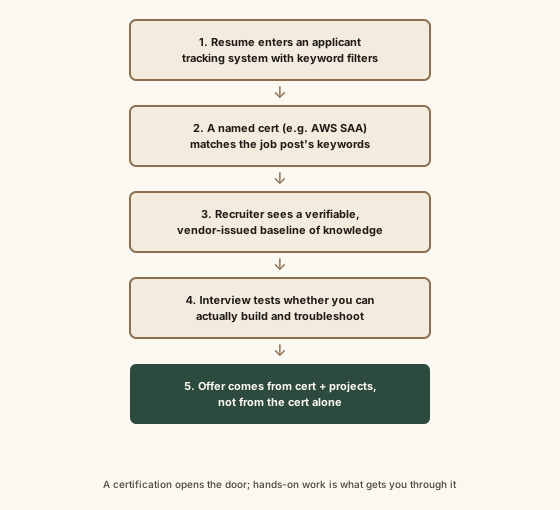
Cloud certifications from Amazon Web Services (AWS), Microsoft Azure and Google Cloud are vendor-issued credentials that confirm you passed a proctored exam on that platform. On a resume, they help in three specific ways: they match the exact keywords many job postings and applicant tracking systems screen for, they give a recruiter a standardized and verifiable baseline, and they signal current knowledge because they expire and must be renewed. They come in tiers. Entry-level exams such as AWS Certified Cloud Practitioner (US$100) or Microsoft Azure Fundamentals AZ-900 cover concepts; associate-level exams such as AWS Solutions Architect – Associate (US$150), Azure Administrator AZ-104 and Google Associate Cloud Engineer (US$125) test hands-on skills and carry more weight with employers. AWS certifications are valid for three years, Microsoft role-based certifications must be renewed yearly through a free online assessment, and Google Cloud certifications also require periodic renewal. A certification rarely gets someone hired on its own; paired with projects you can show and explain, it's much more convincing.
Reading time
— 4 min
Updated
— Sep 27, 2026
Fact-reviewed
— Sep 27, 2026
Key Takeaways
Key Takeaways
1A cloud certification gets your resume past keyword filters and gives recruiters a verifiable baseline.
2Associate-level certs (hands-on) count for much more than entry-level ones (concepts), and all of them expire.
3The cert gets you the interview; projects you can show and explain are what get you the job.
The concept
Many companies run their apps on cloud platforms from Amazon (AWS), Microsoft (Azure) or Google. Each offers exams that prove you know its platform. On a resume, a cloud cert works like a recognized stamp: a recruiter who can't judge your technical skills can still see "AWS Certified Solutions Architect – Associate" and know you passed a real, proctored exam. It also helps your resume show up when employers search for those exact words. What it can't do is prove you can build things under pressure. That's what the interview is for, so the people who benefit most combine a cert with a project they can walk through.
Quick check
Why do cloud certifications expire?
Worked examples
Example 1: The help-desk tech moving up (baseline case)
Priya has two years of help-desk experience and wants a junior cloud administrator role. Most postings she finds mention Azure because local employers run Microsoft 365. She skips the fundamentals exam, studies for AZ-104 (Azure Administrator) over three months using Microsoft Learn's free material and a low-cost lab subscription, and passes. Her resume now matches the exact keyword in most postings, and her help-desk experience with user accounts maps directly to what the exam covered. Recruiter callbacks rise because she clears the first screen.
Example 2: Five certs, no interviews (edge case)
Marcus, changing careers from retail, collects five foundational certificates across AWS, Azure and Google in six months. His resume looks busy, but he gets few interviews, and in the ones he does get, he struggles with "walk me through how you'd deploy this." Foundational certs prove vocabulary, not skill. The fix: pick one platform, earn one associate cert, and build one small project (for example, a static website with a database and automated deployment) that he can explain line by line.
Example 3: Writing the resume line (real-world use)
Weak: "Cloud certified." Strong, in a Certifications section: "AWS Certified Solutions Architect – Associate (Amazon Web Services), earned March 2026, valid through March 2029, verification ID linked." Then, in Projects: "Built a serverless expense tracker on AWS (Lambda, API Gateway, DynamoDB); automated deployments with GitHub Actions; cut hosting cost to under $2/month." The first line gets you past the filter; the second gives the interviewer something concrete to ask about, the same logic as quantifying achievements.
Quick check
What was Marcus's real problem?
How it works (visual)
How a cloud certification moves a resume forward
Common mistakes
Common Mistakes
✕
Choosing a platform because it's popular in general, not with your target employers.
→ Search 20 postings for roles you want in your area and count which cloud they name.
✕
Cramming exam dumps instead of practicing in a real account.
→ Use the free tiers or sandbox labs and build things; interviews expose memorized answers quickly.
✕
Letting a certification lapse without noticing.
→ Put the expiry date in your calendar with a reminder 3 months ahead, and list the valid-through date on your resume.
Common misconception
“Getting a cloud certification is enough to land a cloud job.”
A certification is a filter-passer and a trust signal, not a hiring decision. Employers still interview for problem-solving and hands-on skill, and for most roles they weigh experience and demonstrable projects heavily. The strongest combination is one relevant associate-level cert, one or two projects you can explain, and any related work experience, even if it's help-desk or scripting in a different job. For the bigger question of when a cert can stand in for a degree and when it can't, see how certifications compare to a college degree.
What to do next
What to do next
Tally which cloud platform appears most in postings for your target role and location.
Pick the tier that fits: foundational for non-technical roles, associate for hands-on roles.
Plan one small project on the same platform to build while you study.
Add the exact cert name, issuer, dates and verification link to your resume once you pass.
FAQ
FAQ
Related terms
Related terms
Cloud certification
A credential from a cloud provider (AWS, Microsoft, Google) showing you passed its proctored exam on that platform.
Applicant tracking system (ATS)
Software employers use to collect, search and filter resumes, often by keywords from the job posting.
Foundational certification
An entry-level exam covering cloud concepts and services, such as AWS Cloud Practitioner or Azure AZ-900.
Associate certification
A mid-level exam testing practical skills in building or running systems on a platform.
Credential verification
A link or ID (often via a digital badge) that lets an employer confirm your certification is real and current.
This entry was researched from public sources and drafted with AI-assisted tools, then edited — errors are still possible. Spot one, or want a topic covered? Read our disclaimer.
 KnowThis