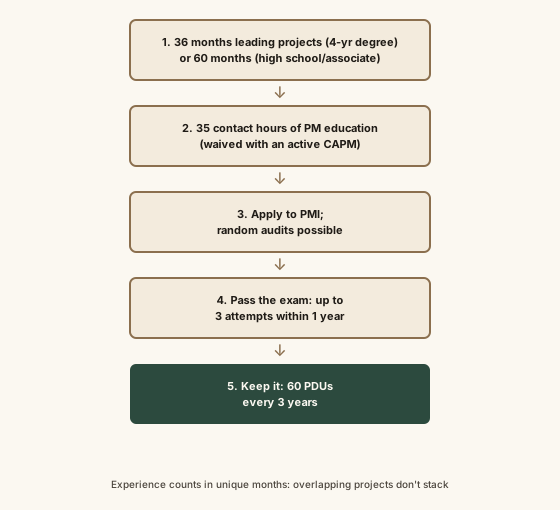
The Project Management Professional (PMP) credential from the Project Management Institute (PMI) is gated by experience, not just an exam. Per PMI's PMP handbook, applicants with a four-year degree need at least 36 months of non-overlapping experience leading and directing projects within the past eight years; applicants with a high school diploma or associate's degree need 60 months; graduates of a GAC-accredited program need 24 months. All applicants also need 35 contact hours of project management education, unless they hold an active CAPM. Applications can be selected for a random audit. The handbook describes a 180-question exam (5 of them unscored pretest questions) with 230 minutes of testing time, covering people, process and business-environment domains and roughly equal parts predictive and agile/hybrid approaches. Candidates get up to three attempts within a one-year eligibility period. To keep the credential, holders earn 60 professional development units (PDUs) every three years.
Reading time
— 4 min
Updated
— Sep 26, 2026
Fact-reviewed
— Sep 26, 2026
Key Takeaways
Key Takeaways
1The PMP is gated by experience: 36 months leading projects with a four-year degree, or 60 months without one, plus 35 hours of project management education.
2The exam itself is long: PMI's handbook lists 180 questions in 230 minutes, about half on traditional (predictive) methods and half on agile or hybrid.
3It isn't a one-time achievement. You keep it by earning 60 professional development units (PDUs) every three years.
The concept
Most exams only check what you know. The PMP also checks what you've done. Before you're even allowed to book the test, you have to show the Project Management Institute that you've spent years actually leading projects, not just working on them, and that you've had at least 35 hours of project management training. Think of it less like a driving test and more like a pilot's license, where logged flight hours come before the check ride. That's exactly why employers value it: it signals real experience plus a shared vocabulary, not just a weekend of study.
You have a bachelor's degree and 30 months leading projects. Can you apply for the PMP?
Worked examples
Example 1: A straightforward application (baseline case)
A marketing coordinator with a bachelor's degree has led product launches for four years. They document 48 months of project leadership across several launches, finish a 35-hour online PMP prep course, and submit the application with a short description of each project. It's approved, and they have one year to pass the exam, with up to three attempts. They meet the 36-month requirement with a year to spare.
Example 2: Overlapping projects (the counting trap)
An IT analyst lists three projects: 18 months, 14 months and 12 months, and assumes that adds up to 44 months. But the projects ran partly at the same time. On a calendar, they span January of one year to June of the next: 30 unique months. Because PMI counts non-overlapping months, the analyst is 6 months short of the 36-month requirement. Drawing a timeline before applying would have caught this.
Example 3: Keeping it after you pass (real-world use)
After passing, a project manager needs 60 PDUs over the next three years. That's about 20 hours a year. They earn most of it from things they already do: a company training on risk management, webinars from a local PMI chapter, and a course on leadership. They log each activity in PMI's system as they go, pay the renewal fee at the end of the cycle, and the credential continues. Someone who waits until the last month usually ends up scrambling. PDUs are PMI's version of a wider system; what continuing education credits actually require compares how other credentialing bodies count them.
Quick check
In Example 2, why does the analyst have 30 months, not 44?
How it works (visual)
The path to getting and keeping a PMP
Common mistakes
Common Mistakes
✕
Adding up project lengths that ran at the same time.
→ Plot projects on a calendar and count unique months only.
✕
Listing work where you contributed but didn't lead.
→ Describe what you led and directed. PMI asks for leadership experience, and an audit will ask your supervisor to confirm it.
✕
Letting the credential lapse by leaving PDUs to the end.
→ Log PDUs as you earn them. Roughly 20 hours a year keeps you on track.
Common misconception
“The PMP is an exam you can pass with enough studying, like any other test.”
The exam is only one step. PMI won't approve you to sit it without years of documented project leadership (36 months with a four-year degree, 60 without) plus 35 hours of project management education, and applications can be audited. For people early in their careers, PMI's CAPM is the credential designed without an experience requirement. The experience gate is also a big part of why employers treat the PMP as a signal of real-world capability rather than test-taking skill. Notice that a degree shortens the path but doesn't replace the experience; how certifications compare to a college degree looks at that trade-off more broadly.
What to do next
What to do next
Draw a timeline of every project you led in the last eight years and count unique months.
Write a short description of each project in terms of what you led: planning, team, budget, risks, delivery.
Confirm your supervisors could sign off on that experience if you're audited.
Complete 35 contact hours from a provider that issues a certificate, or check whether an active CAPM covers it.
Read PMI's current PMP handbook for the latest exam outline and fees before you apply.
FAQ
FAQ
Related terms
Related terms
PMP (Project Management Professional)
A professional certification from the Project Management Institute that requires documented project leadership experience, project management education, and passing an exam.
Contact hours
Hours of formal instruction in project management. PMP applicants need 35, unless they hold an active CAPM.
CAPM
Certified Associate in Project Management, PMI's entry-level credential with no experience requirement. An active CAPM waives the PMP's 35-hour education requirement.
PDU (professional development unit)
PMI's unit for continuing education and giving back to the profession; one PDU generally equals one hour of qualifying activity. PMP holders need 60 every three years.
Application audit
A random check where PMI asks an applicant to provide proof, such as signatures from supervisors and education certificates, before approving them to test.
This entry was researched from public sources and drafted with AI-assisted tools, then edited — errors are still possible. Spot one, or want a topic covered? Read our disclaimer.
 KnowThis