 KnowThis
Key Takeaways
Key Takeaways
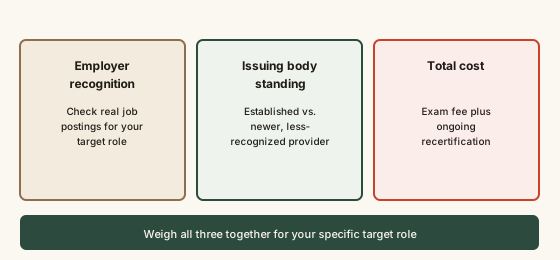
- 1The most reliable signal is whether employers in your specific target role actually list or prefer the credential, not how impressive it sounds in general.
- 2The issuing organization's standing in the field matters as much as the curriculum, since recognition is what gives a certification its practical value.
- 3Total cost and time — including any recertification requirements — should be weighed against the realistic benefit for your specific career goal.
The concept
This is also why the "better" certification for one person can genuinely be the "worse" one for another — the right choice depends on the specific target role and its actual hiring patterns, not a universal ranking of credentials.
Two certifications in the same field have similar course content, but one is issued by a long-established professional organization widely recognized in job postings, and the other by a newer provider rarely mentioned by employers. All else being equal, which factor should carry the most weight in the decision?
Worked examples
Example 1: Checking real job postings before choosing (baseline case)
Example 2: A cheaper certification with weaker recognition (edge case / variation)
Example 3: Factoring in recertification costs over a career (real-world / applied case)
Why does BLS guidance suggest looking at recertification requirements, not just the upfront exam cost, when comparing certifications?
How it works (visual)
Common mistakes
Common Mistakes
Choosing a certification based on general prestige rather than recognition in your specific target role.
→ Check real, current job postings for your target role to see which credentials employers actually list.
Comparing certifications only by upfront exam cost.
→ Factor in ongoing recertification requirements, which add real recurring cost and time over a career.
Assuming similar course content means similar practical career value.
→ Weigh the issuing organization's recognition and standing in the field as heavily as the curriculum itself.
Common misconception
“The 'best' certification in a field is an objective, universal ranking that applies to everyone pursuing that career.”
Per BLS guidance, a certification's practical value comes from employer recognition in a specific role and industry — which can genuinely differ by target job, region, and even employer. A credential that's clearly preferred for one specific role can be largely irrelevant for a related but different role in the same broad field, which is why checking real job postings for your specific target position is more reliable than researching general prestige rankings.
What to do next
What to do next
- Search a sample of real, current job postings for your specific target role and note which certifications actually get listed.
- Check the issuing organization's standing and recognition in the field, not just the course content.
- Add up total cost realistically, including any recurring recertification fees and time commitments.
- When in doubt between two closely matched options, ask people currently working in your target role which credential they see valued in practice.