 KnowThis
Key Takeaways
Key Takeaways
- 1PM certification verifies knowledge of a standardized process framework — how to define scope, schedule work, manage budget and risk — not a specific industry's technical skills.
- 2PMI's PMP requires real project-leadership experience, not just passing an exam, which is why it's treated differently from purely knowledge-based certifications.
- 3The value of the shared vocabulary is portability — a certified project manager can move between industries and still communicate project status the same standardized way.
The concept
This is why hiring managers across very different industries can look at the same certification and understand roughly what a candidate is capable of — it's a shared, testable process language, not a claim about specific technical knowledge.
Why does PMI require verified real-world project leadership experience for the PMP, not just a passing exam score?
Worked examples
Example 1: Coordinating a software release (baseline case)
Example 2: Scope creep on a home renovation (edge case / variation)
Example 3: Switching industries with the same certification (real-world / applied case)
A certified project manager moves from construction into healthcare IT project management. What actually transfers between these very different industries?
How it works (visual)
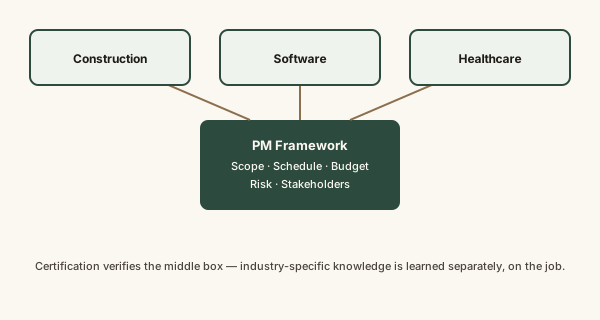
The framework in the middle is what certification actually verifies — the industry-specific knowledge on the outside is learned separately, on the job, in each field.
Common mistakes
Common Mistakes
Assuming a project management certification teaches industry-specific technical skills.
→ Understand it verifies a process framework — technical skills for a specific industry still need to be learned separately.
Silently absorbing small scope additions without formally tracking them.
→ Document and approve every scope change formally, even small ones, since they compound into real schedule and budget impact.
Choosing a certification based on prestige alone without checking its actual experience and exam requirements.
→ Compare specific requirements (experience hours, exam content, renewal requirements) against your actual career goals before committing.
Common misconception
“Project management certification is mostly about memorizing terminology for an exam.”
Per PMI's own certification requirements, the PMP combines a knowledge exam with a mandatory verified experience requirement specifically because project management is treated as an applied skill — the terminology exists to create shared understanding across a team and organization, not as an end in itself, and the credential is designed to verify real applied capability, not just test recall.
What to do next
What to do next
- Check PMI.org for the specific experience-hour and exam requirements for the PMP before assuming you're eligible.
- If you're new to the field, consider whether an entry-level credential (like PMI's CAPM) fits your current experience level better than the PMP.
- Practice formally documenting and approving scope changes on your current projects, even informally, as real applied practice.
- Research whether your target industry values PMP specifically, or an Agile-focused certification more, before choosing which to pursue.