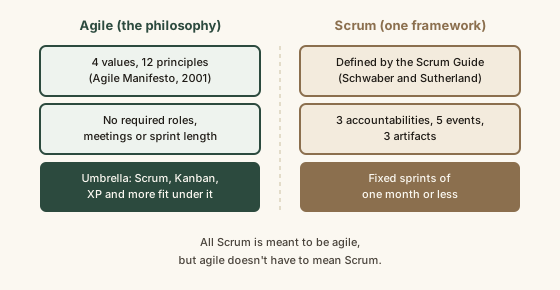
Agile is a philosophy of software and product development defined by the 2001 Manifesto for Agile Software Development's four values and twelve principles, which favor working results, customer collaboration, and responding to change delivered in short, iterative cycles; it prescribes no specific roles, meetings, or timeboxes. Scrum is one concrete framework for putting agile into practice, defined by the Scrum Guide (Schwaber and Sutherland, 2020 edition) with three accountabilities (Product Owner, Scrum Master, Developers), five events (the Sprint, Sprint Planning, Daily Scrum, Sprint Review, Sprint Retrospective), and three artifacts (Product Backlog, Sprint Backlog, Increment), in Sprints of one month or less. Other agile approaches include Kanban and Extreme Programming, and certifications split along the same line: Scrum certifications test the framework, while broader agile credentials such as PMI-ACP cover multiple approaches.
Reading time
— 4 min
Updated
— Sep 25, 2026
Fact-reviewed
— Sep 25, 2026
Key Takeaways
Key Takeaways
1Agile is a philosophy: four values and twelve principles from the 2001 Agile Manifesto about delivering in small steps and adapting to feedback.
2Scrum is one specific framework for doing agile, with defined roles, meetings, artifacts, and Sprints of one month or less.
3Every Scrum team is meant to be agile, but an agile team might use Kanban or another approach instead. Certifications split along the same line.
The concept
Think of agile as a style of cooking, like "cook with fresh ingredients and taste as you go." It tells you what to value, not exactly what to do. Scrum is a specific recipe in that style: it tells you who does what, which meetings to hold, and how long each cycle lasts. You can cook in the fresh-and-taste style without that particular recipe, and you can follow the recipe so mechanically that you forget to taste anything. That's the relationship. When a job ad says "agile environment," it usually means Scrum or something close to it, but the words aren't interchangeable.
If you're weighing a Scrum credential against a broader agile or project management one, the questions in choosing between competing certifications apply directly: what employers in your field ask for, what the exam actually tests, and what it costs to keep current.
Quick check
Which of these is defined by the Scrum Guide but not by the Agile Manifesto?
Worked examples
Example 1: A Scrum team's two weeks (baseline case)
A product team runs two-week Sprints. On day one, Sprint Planning picks items from the Product Backlog, which the Product Owner keeps in priority order, and sets a Sprint Goal. Each morning the Developers hold a 15-minute Daily Scrum to adjust their plan. On the last day, they show the working Increment to stakeholders at the Sprint Review, then hold a Retrospective about how they worked. This is agile (short cycles, feedback, adaptation) done the Scrum way.
Example 2: An agile support team with no Sprints (variation)
An IT support team gets unpredictable tickets all day. Planning two weeks ahead makes little sense, so they use a Kanban board with a limit of five tickets "in progress" at once, pull new work as capacity frees up, and review their cycle times every month to improve. No Scrum Master, no Sprints, and it's still agile: small batches, visible work, continuous improvement.
Example 3: "Scrum" in name only (applied case)
A company renames its weekly status meeting "Sprint Review," makes the project manager the "Scrum Master" who assigns tasks, and fixes a 12-month feature list up front that never changes. It has Scrum's vocabulary but none of the Manifesto's values: no customer feedback loop and no adapting the plan. This pattern is common enough that practitioners call it "cargo cult agile," and it's worth recognizing in interviews and job descriptions.
Quick check
Why is the support team in Example 2 still considered agile without using Scrum?
How it works (visual)
Agile is the umbrella; Scrum is one framework under it
Common mistakes
Common Mistakes
✕
Using 'agile' and 'Scrum' interchangeably in interviews or on a resume.
→ Say which framework you actually used (Scrum, Kanban, a hybrid) and what your role was. Hiring managers notice the precision.
✕
Treating the Scrum Master as the team's manager who assigns tasks.
→ Per the Scrum Guide, the Scrum Master coaches and removes impediments; Developers decide how to do the work.
✕
Buying a Scrum certification when your target jobs mostly ask for broader project management credentials.
→ Check real job postings in your field first, then pick the credential they name.
Common misconception
“Agile and Scrum are the same thing.”
Agile is defined by a short manifesto of values and principles and deliberately prescribes no process. Scrum is a specific framework with defined accountabilities, events, and artifacts, set out in the Scrum Guide. Scrum is the most widely used way to practice agile, which is why the terms get blurred, but Kanban, Extreme Programming, and hybrids are agile too, and a team can run every Scrum meeting while ignoring the values that make it agile.
What to do next
What to do next
Read the Agile Manifesto's one page and the Scrum Guide (under 15 pages). Both are free and are the primary sources every certification builds on.
Look at 10 job postings for your target role and note whether they ask for Scrum specifically, agile generally, or a project management credential.
If you're on a team now, identify which framework it actually uses and which Scrum events or agile principles are missing.
Pick a certification only after that check, using our guide to choosing between competing certifications.
FAQ
FAQ
Related terms
Related terms
Agile
An approach to building products in short, iterative cycles with frequent feedback, defined by the four values and twelve principles of the 2001 Agile Manifesto.
Scrum
A specific lightweight framework for agile work, defined by the Scrum Guide, built around fixed-length Sprints, three accountabilities, five events, and three artifacts.
Sprint
In Scrum, a fixed period of one month or less in which the team turns selected work into a usable Increment. A new Sprint starts right after the previous one ends.
Product Owner
The Scrum accountability for maximizing the value of the product, mainly by ordering and communicating the Product Backlog.
Scrum Master
The Scrum accountability for helping the team and organization use Scrum effectively, removing impediments, and coaching, rather than managing the team's tasks.
Kanban
An agile method that visualizes work on a board and limits how much work is in progress at once, using continuous flow rather than fixed Sprints.
This entry was researched from public sources and drafted with AI-assisted tools, then edited — errors are still possible. Spot one, or want a topic covered? Read our disclaimer.
 KnowThis