What a CompTIA Security+ Certification Actually Covers
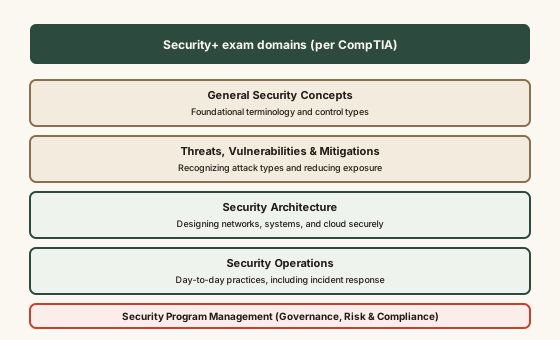
CompTIA Security+ is a vendor-neutral certification that tests a candidate's foundational cybersecurity knowledge across a defined set of exam domains — per CompTIA, these cover general security concepts, threats/vulnerabilities/mitigations, security architecture, security operations, and security program management (governance, risk, and compliance) — and it is positioned as an entry-level credential for people moving into a first security-focused IT role, not an advanced or offensive-hacking certification.
Reading time
— 4 min
Updated
— Sep 23, 2026
Fact-reviewed
— Sep 23, 2026
Key Takeaways
Key Takeaways
1Security+ tests foundational cybersecurity knowledge across defined exam domains, not advanced or offensive hacking skills.
2Per CompTIA, the certification is vendor-neutral — it covers general security concepts rather than one company's specific products.
3It's positioned as an entry point into a first security-focused IT role, commonly used as a baseline credential before pursuing more specialized certifications.
The concept
Security+ is one of the most common entry-level certifications people pursue when moving into cybersecurity work. It doesn't teach you to be a hacker or a penetration tester — it tests whether you understand the basics: what kinds of threats and attacks exist, how a secure network and system are generally built, how to actually implement basic security controls, how a team responds when something goes wrong, and how an organization manages security policy and risk at a higher level. It's deliberately broad rather than deep, which is exactly the point for someone who's new to the field and needs to show a baseline of competence across the whole subject.
This breadth is also why Security+ is commonly described as a stepping-stone credential — it's designed to establish that a candidate understands the full landscape of the field before they specialize into a narrower path like penetration testing, security analysis, or cloud security.
Quick check
What best describes what CompTIA Security+ actually tests, per CompTIA's own exam objectives?
Worked examples
Example 1: A recent IT support worker moving into security (baseline case)
Someone with a year or two of general IT help-desk experience wants to move into a security-focused role. Security+ fits this transition directly — it assumes some general IT background (which CompTIA itself notes as recommended, though not a formal prerequisite) and builds on it with security-specific concepts across all the exam's domains, without expecting prior specialized security experience.
Example 2: Someone expecting a hands-on hacking credential (edge case / variation)
A candidate who wants to learn offensive techniques like penetration testing might be surprised that Security+ spends relatively little time on hands-on exploitation and much more on recognizing threat types, understanding architecture, and governance concepts. That candidate would likely be better served pursuing Security+ first as a foundation, then a more specialized, advanced credential afterward that focuses specifically on offensive security skills.
Example 3: Using the certification to qualify for a specific job requirement (real-world / applied case)
Certain employers, including some U.S. government and defense-related roles, list Security+ as meeting a baseline certification requirement for IT positions that touch security responsibilities. A candidate targeting these roles pursues Security+ not just for the knowledge itself but because the certification is explicitly named as an acceptable credential for that requirement.
Quick check
Why might a candidate who wants to become a penetration tester still start with Security+ rather than skipping straight to an offensive-security certification?
How it works (visual)
The exam domains Security+ tests, per CompTIA
Common mistakes
Common Mistakes
✕
Assuming Security+ is a hands-on hacking or penetration-testing credential.
→ Understand it's a broad, foundational exam covering concepts, architecture, operations, and governance — not advanced offensive techniques.
✕
Treating Security+ as vendor-specific product training.
→ Recognize it's vendor-neutral, per CompTIA — it tests concepts that apply across vendors, not one company's configuration steps.
✕
Skipping general IT experience before attempting Security+.
→ CompTIA recommends foundational IT knowledge first, even though it isn't a strict formal prerequisite — the material assumes some baseline IT familiarity.
Common misconception
“A CompTIA Security+ certification means someone is qualified to actively defend a network against real attackers or perform penetration testing.”
Per CompTIA's own exam objectives, Security+ tests foundational knowledge — recognizing threat types, understanding secure architecture, following operational and incident-response practices, and understanding governance and risk concepts. It establishes a knowledge baseline for an entry-level security role, not hands-on proficiency defending live systems or conducting offensive security testing, which are built through further specialized certifications and real job experience.
What to do next
What to do next
Review CompTIA's current published exam objectives directly, since specific domain weights and content shift between exam revisions.
Assess whether you already have the general IT background CompTIA recommends before attempting the exam.
Decide whether Security+ fits your goal as a foundational credential before a more specialized security path, or as a standalone baseline requirement for a specific job.
Compare Security+ against other entry-level IT certifications relevant to your target role before committing time and cost to one exam.
FAQ
FAQ
Related terms
Related terms
Vendor-neutral certification
A credential that tests general knowledge of a subject rather than skills specific to one company's product — Security+ tests general cybersecurity concepts, not, say, a specific brand of firewall.
Exam domain
One of the defined topic areas a certification exam is organized into, each carrying a set percentage weight of the total exam.
GRC (governance, risk, and compliance)
The set of practices an organization uses to set security policy, evaluate and manage risk, and meet legal or regulatory requirements.
Incident response
The structured process an organization follows to detect, contain, and recover from a security incident, such as a breach or malware infection.
Two certifications in the same field have similar course content, but one is issued by a long-established professional organization widely recognized in job postings, and the other by a newer provider rarely mentioned by employers. All else being equal, which factor should carry the most weight in the decision?
This entry was researched from public sources and drafted with AI-assisted tools, then edited — errors are still possible. Spot one, or want a topic covered? Read our disclaimer.
 KnowThis