 KnowThis
Key Takeaways
Key Takeaways
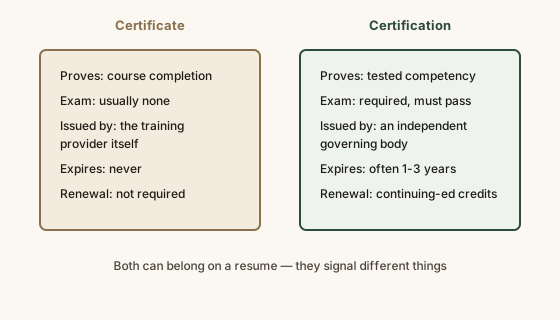
- 1A certificate proves you completed a course — it's issued by the training provider, usually needs no exam, and never expires.
- 2A certification proves tested competency — it's issued by an independent governing body, requires passing an exam, and often expires unless renewed.
- 3Employers generally weigh a certification more heavily for a specific skill claim, precisely because an independent third party verified it, not the provider that sold you the training.
The concept
Neither type of credential is inherently "better" in every situation — a certificate can be exactly the right signal for demonstrating you've been exposed to a new tool, while a certification is the stronger signal when a role specifically requires verified, tested competency.
A job posting requires 'PMP certification or equivalent.' A candidate has completed an online project management course and received a certificate of completion, but never took an independent exam. Does this satisfy the requirement?
Worked examples
Example 1: A software training certificate (baseline case)
Example 2: A prep course vs. the actual certification exam (edge case / variation)
Example 3: A lapsed certification (real-world / applied case)
Why can a certification lapse or expire while a certificate from a completed course never does?
How it works (visual)
Common mistakes
Common Mistakes
Listing a course-completion certificate on a resume as if it's an equivalent to a recognized certification.
→ Be precise about which credential you hold — listing a certificate honestly is still valuable, but conflating it with a certification can look misleading if checked.
Letting a certification lapse without realizing continuing education was required.
→ Track your certification's renewal cycle and continuing education requirements from day one, not just when a reminder email arrives.
Assuming any credential with 'certified' in its name went through an independent exam.
→ Check specifically who issues the credential and whether it requires passing an independent exam before assuming it carries certification-level weight.
Common misconception
“Certificates and certifications are basically interchangeable terms for the same kind of credential.”
They signal fundamentally different things. A certificate says "I completed this training," issued by whoever sold you the training. A certification says "an independent body tested me and verified I meet a defined standard," issued by an organization with no financial stake in whether you personally passed. For roles that specifically require verified competency, that difference is exactly what an employer is checking for.
What to do next
What to do next
- Before enrolling, check whether a program grants a certificate or an actual certification — the marketing language alone won't always make this clear.
- If a job posting requires 'certification,' confirm a course-completion certificate genuinely satisfies it before assuming it does.
- Track continuing education requirements and renewal deadlines for any certification you hold, from the day you earn it.
- List credentials precisely on a resume — the specific issuing body and whether an exam was required, not just the credential's name.