 KnowThis
Key Takeaways
Key Takeaways
- 1A skills gap analysis compares a specific target skill list and proficiency level against your honestly rated current level, turning a vague sense of needing to improve into a concrete, ranked list.
- 2Not all gaps are equally worth closing — a gating skill that's required for every posting in a target role blocks progress in a way a merely nice-to-have gap doesn't.
- 3The comparison only works if the target side is real and specific — pulled from actual job postings, an occupational profile, or a manager's stated expectations, not a general impression of what the role probably needs.
The concept
Once the four-step loop is visible, the practical skill becomes pulling a real, specific target list — not a vague impression of the role — and being honest, not generous, when rating the current-state side.
What makes a skills gap analysis different from simply feeling like you should improve at your job?
Worked examples
Example 1: Finding two clear gaps against a real target (baseline case)
An operations analyst wants to move into a more data-focused role. They pull five real job postings for that target role and list the five skills that appear most consistently: spreadsheet analysis, a specific query language, a dashboarding tool, stakeholder presentations, and basic statistics. Rating themselves honestly against each on a simple scale, they find they're already strong in spreadsheet analysis and presentations, adequate in statistics, but genuinely weak in the query language and the dashboarding tool. The analysis turns a vague "I should learn more data skills" into two specific, named gaps to close.
Example 2: Confusing a nice-to-have gap with a gating one (edge case / variation)
A candidate has a long list of skill gaps from several job postings, including one required certification that nearly every posting lists as mandatory. How should these gaps generally be prioritized?
Example 3: Comparing a targeted plan against a vague one (real-world / applied case)
Two employees both want to move into a team-lead role within a year. One does a structured gap analysis: pulls the actual internal job description, an O*NET-style occupational profile for supervisory skills, and a manager conversation about specific expectations — then closes the two gating gaps it surfaces (a scheduling certification and formal delegation experience) within six months. The other spends the same period taking a broad mix of courses based on a general sense of what leaders "probably need," without comparing against a specific target. When the role opens, the first employee meets every required qualification; the second has learned real things, but not necessarily the ones the actual posting required.
Why might a structured skills gap analysis lead to being ready for a target role faster than a broad, unranked effort to "improve leadership skills" generally?
How it works (visual)
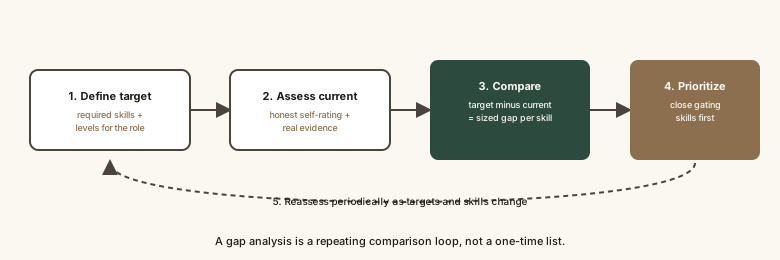
The loop repeats — a gap analysis isn't a one-time list, since both the target (as roles evolve) and the current state (as skills develop) keep changing.
Common mistakes
Common Mistakes
Basing the target skill list on a general impression of the role instead of real job postings or a documented occupational profile.
→ Pull the target skill list from several real postings, an occupational profile, or a direct conversation with a manager about actual expectations.
Rating your own current skill level generously instead of honestly, or without any corroborating evidence.
→ Cross-check self-ratings against past feedback, completed work, or a skills test where one's available — an inflated current-state rating hides real gaps.
Treating every identified gap as equally important, regardless of whether it's required for the role or just a preference.
→ Separate gating skills — required across most postings for the target role — from nice-to-have skills, and prioritize closing the gating ones first.
Common misconception
“A skills gap analysis is the same thing as making a list of skills you'd like to learn or improve.”
A real skills gap analysis compares two specific, sized lists — a target role's required skills and levels, and your honestly rated current levels — rather than a general wish list of skills that sound useful. Without a real, specific target to compare against, there's no actual gap being measured, just a list of things that seem valuable in the abstract, which is a much weaker basis for deciding what to spend limited development time on.
What to do next
What to do next
- Pull a specific target skill list for your goal from several real job postings, an occupational profile, or a direct conversation with a manager.
- Rate your current level in each target skill honestly, cross-checked against real evidence like past feedback or completed work.
- Sort the resulting gaps by how many postings or requirements list each one as required, and prioritize closing the gating gaps first.
- Read Lateral Move vs. Promotion next to see whether a lateral move could be a faster way to close a gap that's blocking your target role.