 KnowThis
Key Takeaways
Key Takeaways
- 1A promotion changes your formal job level (and usually pay band and authority); a lateral move changes your role, team, or function while the level stays the same.
- 2Organizations track level/pay band and functional assignment as two mostly independent things, which is why a move can change one without touching the other.
- 3A lateral move is sometimes deliberately used as a stepping stone toward a future promotion, so it isn't automatically a step backward even without an immediate title or pay change.
The concept
Once level and function are seen as separate axes, the practical question for any move becomes: which axis is actually changing here, and does that match what I'm trying to build toward?
What structurally distinguishes a promotion from a lateral move in most organizations?
Worked examples
Example 1: A clear promotion versus a clear lateral move (baseline case)
A senior analyst is promoted to team manager: new title, a higher pay band, and three direct reports — a clear level change. At the same company, a different analyst moves from the marketing team to the product team, keeping the same title, the same pay band, and no new direct reports — a clear lateral move. The two changes look similar on an org chart (both are "new roles") but sit on entirely different axes: one moved up in level, the other moved sideways in function.
Example 2: A lateral move used as a deliberate stepping stone (edge case / variation)
An employee takes a lateral move with no pay or title change, into a team known for a strong internal promotion track record. How should this move generally be understood?
Example 3: Turning down a lateral move that later mattered (real-world / applied case)
An employee is offered a lateral move into a new function and turns it down, reasoning that any move without a title or pay increase isn't worth the disruption. Eighteen months later, a promotion opens up that specifically requires cross-functional experience in the domain the declined lateral move would have provided. A different colleague who took a similar lateral move earlier is considered for the role instead, purely on scope of experience — the level never changed for either person until that point, but only one of them had built the functional breadth the promotion required.
Why might declining a lateral move end up limiting a later promotion opportunity, even though the lateral move itself involved no level or pay change?
How it works (visual)
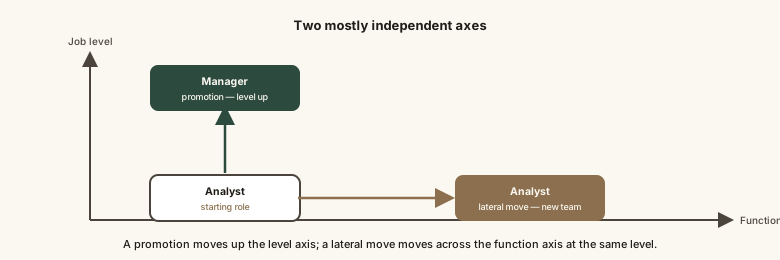
Seen this way, the real question for any specific move isn't "did my title change" — it's which axis actually moved, and whether that's the axis you were trying to move on.
Common mistakes
Common Mistakes
Assuming any move without a title or pay change is automatically a step backward.
→ Evaluate what the move actually changes on the functional/scope axis, not only whether the level axis moved.
Treating a lateral move offer as equivalent in value to declining it, without asking what future opportunities it opens up.
→ Ask directly how the team or function you'd be moving into is regarded for future promotions before deciding.
Expecting a lateral move to automatically lead to a promotion on its own, without building real, demonstrated impact in the new function.
→ Treat a strategic lateral move as an opportunity to build relevant experience — the move itself doesn't guarantee the next level, only a better position to earn it.
Common misconception
“A lateral move is a wasted move — real career progress only comes from a promotion.”
Because job level and functional assignment are tracked as mostly independent things inside most organizations, a lateral move can meaningfully change your scope, visibility, or skill breadth even while the level axis stays flat. Some lateral moves are made deliberately as a stepping stone into a function with a stronger track record of producing promotions. The level not changing immediately doesn't mean nothing of career value changed — it means a different axis moved.
What to do next
What to do next
- Before evaluating any internal move, ask specifically which axis it changes — job level/pay band, functional scope, or both.
- If offered a lateral move, ask how the destination team or function is regarded for future promotions before deciding.
- If turning down a lateral move, weigh the functional experience or visibility it would have built, not just the immediate title and pay.
- Read What a Skills Gap Analysis Actually Is next to check whether a lateral move would close a gap your target promotion actually requires.