 KnowThis
Key Takeaways
Key Takeaways
- 1A single bad week or a hard project is noise; a persistent, non-cyclical gap in growth, pay, or fit sustained across multiple review cycles is a real signal.
- 2Trying a credible path to closing the gap while staying — a direct conversation, a raise request, an internal move — and having it not work is a stronger indicator than never having tried.
- 3Sometimes the signal is external and structural (industry contraction, shrinking demand for a specific skill set) even when the day-to-day role and manager relationship are currently fine.
The concept
Once satisfaction is treated as a signal to sample over time rather than a single reading, the practical test becomes: has this persisted across a real stretch, and has a genuine attempt to fix it while staying already failed?
What generally distinguishes a real signal that it's time to change jobs from ordinary noise, like a single hard week or project?
Worked examples
Example 1: A rough month against a solid two-year trend (baseline case)
An employee has a genuinely difficult month covering a demanding, understaffed project, and briefly feels certain it's time to leave. Looking back over the prior two years, though, their scope, title, and compensation have all grown steadily, and the current project is a known, temporary spike rather than the normal state of the role. Recognizing the difficult month as noise against an otherwise solid trend, they wait it out rather than acting on the temporary signal — and satisfaction returns to its usual level once the project wraps.
Example 2: A flat trajectory with a failed attempt to fix it (edge case / variation)
An employee's title and pay have been flat for three review cycles despite strong performance, and a direct conversation about it produced no change. How should this situation generally be read?
Example 3: A structural signal from outside the company (real-world / applied case)
An employee likes their manager, their day-to-day work is going well, and there's no specific internal complaint. At the same time, the broader industry segment they work in is visibly contracting, and job postings requiring their specific skill set have been shrinking regionally for over a year. Despite the current role feeling fine day to day, the signal here isn't coming from inside the job — it's coming from the surrounding market. Recognizing this as a real structural signal, they begin a proactive search well before any internal problem appears, rather than waiting for a personal complaint that may never come before the external situation forces the issue.
An employee has no complaint about their current role or manager, but the broader industry for their specific skill set is visibly contracting. What does this situation call for?
How it works (visual)
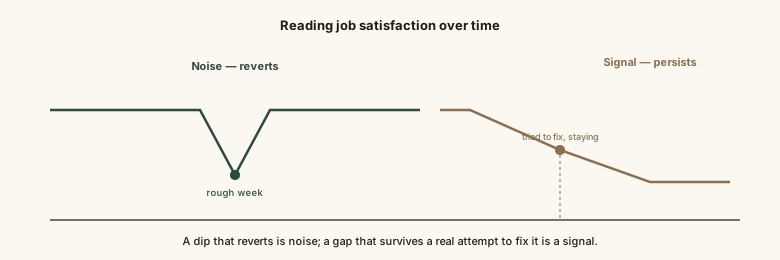
The practical test isn't how bad a single moment feels — it's whether the gap persists once the temporary trigger has passed, and whether a real attempt to close it while staying actually worked.
Common mistakes
Common Mistakes
Deciding to leave based on a single bad week or a difficult project without checking it against the longer trend.
→ Look back over the past year or two of growth, pay, and fit before acting on a single rough stretch — a temporary dip usually reverts.
Leaving without first attempting a credible internal path to close the gap, like a direct conversation or an internal transfer.
→ Try a specific, documented internal attempt to fix the gap first — the result of that attempt is itself useful evidence either way.
Waiting for a personal, internal complaint before searching, even when an external, industry-level signal is already visible.
→ Treat a visible industry contraction or shrinking regional demand for your specific skill set as a real signal on its own, independent of how the current role feels day to day.
Common misconception
“If your current manager and day-to-day work are fine, there's no real reason to be job searching.”
A structural signal to change jobs doesn't always come from inside the current role — it can come from outside it, such as an entire industry segment contracting or demand for a specific skill set shrinking in a region, while the day-to-day manager relationship and current project both feel completely fine. Waiting for a personal, internal complaint to appear before acting on a visible external trend means starting the search later than the situation actually calls for.
What to do next
What to do next
- Before acting on a rough stretch, check it against the last one to two years of growth, pay, and fit to see whether it's a temporary dip or a persistent trend.
- If a gap looks persistent, try one credible internal path to close it first — a direct conversation, a raise request, or an internal transfer — and treat the result as real evidence.
- Separately check for external, structural signals (industry contraction, shrinking regional demand for your specific skill set) even if the internal situation currently feels fine.
- Read What a Performance Review Actually Evaluates next to make sure a flat trajectory is actually about growth and fit, not a rubric component you haven't addressed yet.