 KnowThis
Key Takeaways
Key Takeaways
- 1A multiple-choice question has three engineered parts: a stem stating exactly one thing being tested, a key that is the credited answer, and distractors written from real, common errors rather than random wrong text.
- 2Distractors are the most deliberately built part of the question — a well-written distractor reflects a specific, documented misconception, which is why a question can often be answered by recognizing which error each wrong option represents.
- 3Items are piloted and revised using real response data (difficulty and discrimination statistics), so a released exam question has usually already been rewritten at least once based on how real test-takers actually answered it.
The concept
Once you see the stem-key-distractor structure, a question stops looking like a coin flip between four similar statements and starts looking like what it actually is: one precise thing being tested, surrounded by specific, identifiable wrong turns.
Why are well-written distractors on a multiple-choice question usually built from documented, common errors rather than random wrong statements?
Worked examples
Example 1: A well-built item (baseline case)
A math question asks for the result of a specific two-step calculation. The key is the correct answer. One distractor is the answer you get if you do the two steps in the wrong order (a real, common sequencing error). Another distractor is the answer you get from a common sign mistake. A third distractor is the result of only completing the first step and stopping. Every wrong answer corresponds to a specific, identifiable way of getting the problem wrong — someone reviewing which option a student picked can tell roughly what went wrong in their reasoning, not just that they got it wrong.
Example 2: A poorly piloted item (edge case / variation)
A released multiple-choice question has one distractor that almost no test-taker ever selects, based on real response data. What does this actually indicate about the question?
Example 3: Reading a real exam question with this in mind (real-world / applied case)
A test-taker faces a science question they don't immediately know the answer to. Instead of scanning for the option that "feels familiar," they read each wrong option and ask what specific mistake would lead someone there. One option matches what you'd get from confusing two similar-sounding terms — a mistake they remember making earlier in their studying. Recognizing that trap lets them rule it out with actual reasoning, not a hunch, narrowing the field before committing to an answer among the rest.
A test-taker doesn't immediately know the answer to a question but recognizes that one option matches a specific mistake they remember making while studying. What's the most useful next step, based on how these items are actually built?
How it works (visual)
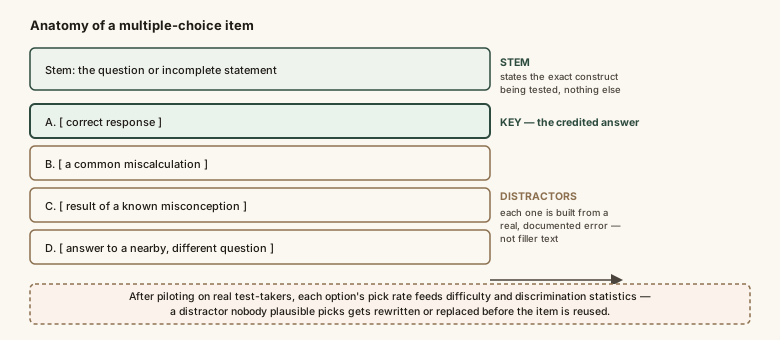
Every part of a released question has usually already survived at least one round of revision based on how real test-takers responded to it — nothing on the page is there by accident.
Common mistakes
Common Mistakes
Scanning options for the one that 'sounds right' instead of reasoning through why each wrong option is wrong.
→ Treat each distractor as a specific claim to evaluate — ask what error would produce that exact answer.
Assuming a question with an unusual or oddly specific wrong answer is a trick question.
→ An oddly specific distractor is often built from a real documented error, not a trick — it usually points to exactly the misconception being tested for.
Treating every question as a pure 50/50-style guess once two options seem plausible.
→ Keep applying reasoning to distinguish the remaining options — a well-piloted item is designed so the two most plausible options differ on a real, identifiable point, not arbitrarily.
Common misconception
“Multiple-choice questions are inherently easier or 'less rigorous' than written or open-ended questions, since you're just picking from a list.”
A well-built multiple-choice item is deliberately engineered to require the same underlying understanding a written question would, using distractors constructed from specific, real misconceptions rather than a blank page. Recognizing why each wrong option is wrong often requires the same depth of understanding as producing the right answer from scratch would — the format changes how the answer is expressed, not necessarily how much genuine understanding is required to get there. What actually varies rigor is item quality, not the multiple-choice format itself.
What to do next
What to do next
- When reviewing a practice question you got wrong, identify the specific error the distractor you picked represents, not just that it was wrong.
- While studying, note the common mistakes you personally make on a topic — those are exactly the kind of errors distractors are often built from.
- On a real exam, evaluate each option by asking what specific reasoning would lead there, rather than scanning for the one that 'feels' correct.
- Read Process of Elimination Explained next to turn this understanding of distractor design into a concrete elimination strategy.