 KnowThis
Key Takeaways
Key Takeaways
- 1A time budget starts with subtracting a reserved review block from the total exam time before dividing by the number of questions — the reserve is planned up front, not whatever happens to be left over.
- 2Checking your actual pace against a set checkpoint partway through catches drift early enough to correct it, instead of discovering a pacing problem only once time is nearly out.
- 3The sunk-cost trap — staying on one hard question because of time already spent on it — is the single most common way a workable time budget falls apart in practice.
The concept
Once time budgeting is treated as a feedback loop rather than a single countdown, the fix for most pacing failures becomes obvious: build in a checkpoint, and treat a hard question's time budget as a hard stop, not a soft target.
Why does checking your pace at a single planned checkpoint partway through an exam matter more than just knowing the total time limit?
Worked examples
Example 1: Setting a baseline budget (baseline case)
An exam has 60 minutes and 40 questions. Before starting, the test-taker reserves 8 minutes for reviewing flagged questions, leaving 52 minutes for a first pass. Divided across 40 questions, that's 1.3 minutes per question, or roughly 26 minutes to reach question 20 — the halfway checkpoint. At the 26-minute mark, they check their progress: they're on question 21, slightly ahead of pace, so they continue at the same rate with confidence instead of guessing whether they're on track.
Example 2: Falling behind pace and correcting mid-exam (edge case / variation)
A test-taker checks their planned mid-exam checkpoint and finds they're noticeably behind pace. What's the most useful next step, based on how a time budget is meant to function?
Example 3: The sunk-cost trap on a single hard question (real-world / applied case)
A test-taker budgeted about 90 seconds per question but hits one particularly difficult problem. After two minutes on it, they're close to a solution, so they keep going. At four minutes, they're still not there, but by now they've invested so much time that stopping feels like wasting it — so they push on. By the time they finally get an answer, six minutes have passed on a single question, and they're forced to rush through the last several questions of the exam, several of which they would have answered correctly with normal time. The time already spent on the hard question was gone regardless of the decision to continue; the only real cost was the rushed questions that followed.
A test-taker spends far more time than budgeted on one hard question because they feel they've already invested too much to stop. What reasoning error does this illustrate?
How it works (visual)
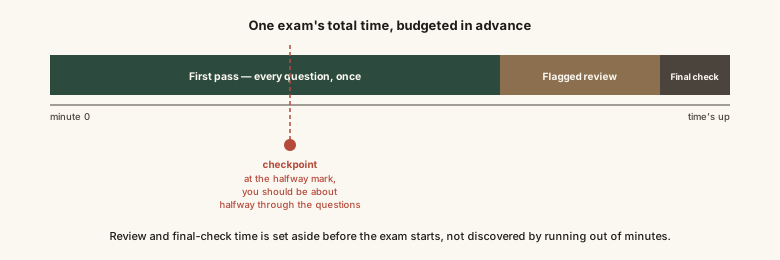
The review and final-check time exist because they were planned before the exam started, not because there happened to be minutes left over.
Common mistakes
Common Mistakes
Starting an exam with no planned checkpoint, so a pacing problem is only discovered when time is nearly out.
→ Set at least one mid-exam checkpoint (a specific minute paired with a target question number) before you start.
Continuing to work a single hard question well past its budgeted time because of time already invested in it.
→ Set a hard time cap per question in advance, flag it, and move on when the cap is reached — treat time already spent as gone either way.
Leaving zero dedicated time for reviewing flagged questions or checking the answer sheet.
→ Reserve a fixed block for review before dividing the remaining time across questions, so review time is planned rather than accidental.
Common misconception
“If you know the material well enough, you don't really need a time-budgeting plan — you'll just naturally finish in time.”
Knowing the material affects how quickly you can answer a question once you reach it, but it doesn't by itself protect against uneven pacing, a run of unusually difficult questions early on, or the sunk-cost trap of over-investing in one hard problem. Even strong test-takers can run out of time on an otherwise-manageable exam without an explicit plan, because unaided time perception under pressure is unreliable — a set checkpoint is what actually catches a pacing problem early enough to fix it, regardless of how well-prepared someone is.
Try it yourself
Enter the exam's total time, how many minutes you want to reserve for reviewing flagged questions, and the number of questions, to get a baseline pace per question.
What to do next
What to do next
- Before the exam starts, subtract a reserved review block from the total time, then divide what's left by the number of questions to get a baseline pace.
- Set one mid-exam checkpoint — a specific minute paired with a target question number — and actually check it when the time comes.
- Decide on a hard time cap for any single question in advance, and commit to flagging and moving on once it's reached, regardless of how close you feel to an answer.
- Read Process of Elimination Explained next, since a fast, reasoned elimination pass is one of the most direct ways to stay inside a tight per-question budget.