 KnowThis
Key Takeaways
Key Takeaways
- 1Process of elimination works by ruling out options for a specific, verifiable reason — not by a hunch about which option 'feels' wrong.
- 2Each verified elimination mechanically raises the odds of a correct guess on the remaining options, since the guessing probability is simply one divided by the number of options left.
- 3It's most powerful as a confidence-building tool between two remaining options, not just as a way to survive total uncertainty — partial knowledge is often enough to eliminate two of four options even without knowing the right answer outright.
The concept
Once elimination is understood as a verification process with a real mathematical payoff, it stops being a last resort and becomes a first move worth trying on any question you're not fully certain about.
Why does eliminating two of four answer options, each for a specific verified reason, actually improve the odds of a correct guess on what remains?
Worked examples
Example 1: Eliminating two clearly wrong options (baseline case)
A question has four options. A test-taker doesn't know the answer outright, but recognizes that one option contradicts a basic fact they're certain of, and another option answers a related but different question than the one actually asked. Both are ruled out for specific, statable reasons. That leaves two options. Even without further certainty, a guess between the remaining two now carries 50% odds instead of the original 25% — a real improvement achieved through reasoning, not luck.
Example 2: A hunch-based elimination that backfires (edge case / variation)
A test-taker eliminates an answer option because it 'feels unlikely' with no specific stated reason, and it turns out to have been the correct answer. What does this illustrate?
Example 3: Elimination on partial knowledge under time pressure (real-world / applied case)
On a timed exam, a test-taker reaches a question outside their strongest area. They don't know the correct answer with confidence, but they can quickly verify that one option uses a term that doesn't apply to the situation described, and another option is the answer to a slightly different, more common version of the question — a distractor built from a known mix-up. Both eliminations take only a few seconds each, backed by specific reasoning. With two options left and the clock running, they make an informed guess rather than a blind one, and move on within their time budget.
Under time pressure, a test-taker can't fully solve a question but can quickly rule out two options for specific reasons. What's the most effective use of process of elimination in this situation?
How it works (visual)
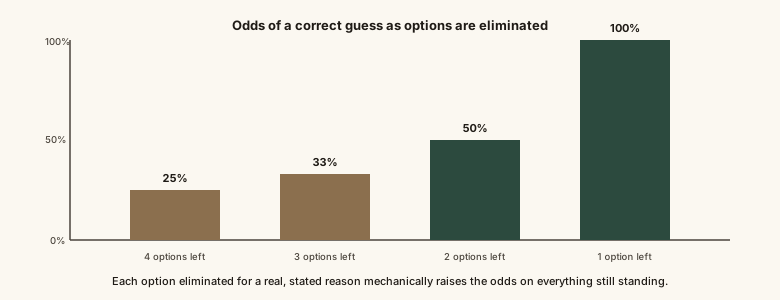
The improvement in odds is arithmetic, not a feeling — which is exactly why it holds up under time pressure and partial knowledge alike.
Common mistakes
Common Mistakes
Eliminating an option based on a vague feeling ('it just seems wrong') instead of a specific, checkable reason.
→ Only eliminate an option when you can state the specific reason it's incorrect — otherwise leave it in the field.
Treating process of elimination as only a last resort for total uncertainty.
→ Apply it on any question where you have partial knowledge, even if you can only confidently eliminate one or two options.
Spending disproportionate time trying to eliminate every option with full certainty instead of stopping once the odds are good enough given remaining time.
→ Eliminate what you can quickly and reliably justify, then make an informed guess among what's left rather than chasing full certainty under time pressure.
Common misconception
“Process of elimination is basically a fallback for guessing — it's a weaker strategy than actually knowing the answer.”
Process of elimination is a legitimate reasoning strategy with a real, calculable payoff: each option ruled out for a specific, verifiable reason mechanically raises the probability that a guess among what remains lands on the correct answer. It doesn't require knowing the correct answer directly — it works by verifying that other options are false, which is often achievable with partial knowledge even when the correct answer isn't immediately obvious. Used well, it's a deliberate application of the same verification reasoning used to check any claim, not a lesser substitute for it.
Try it yourself
Enter the total number of answer options and how many you can confidently, verifiably rule out, to see the odds of a correct guess among what's left.
What to do next
What to do next
- On a question you're not fully certain about, look for at least one option you can rule out for a specific, statable reason before guessing.
- Practice distinguishing a verified elimination (a checkable reason) from a hunch-based one (a vague feeling) while reviewing practice questions.
- Set a time limit for how long to spend eliminating options on any single question, so the strategy fits inside your overall time budget.
- Read How Multiple-Choice Exams Are Actually Designed next to better recognize which distractors are built from common errors worth eliminating first.