What Continuing Education Credits Actually Require
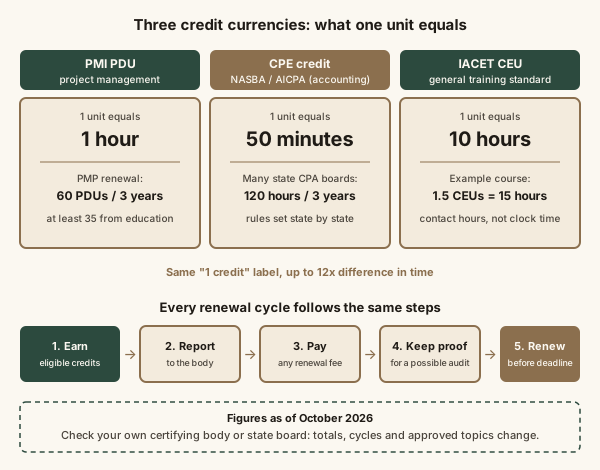
Continuing education credits are the way certifying bodies and licensing boards check that holders keep learning after they pass the exam. Each body sets a cycle, a total, rules on which activities count, and documentation you must keep in case of audit, and the units are not interchangeable. As of October 2026: PMI's PMP requires 60 professional development units (PDUs) every three years, where one PDU equals one hour, with at least 35 from education split across PMI's three skill areas and no more than 25 from 'giving back' activities. CompTIA's Security+ requires 50 continuing education units (CEUs) over three years, and earning a higher CompTIA certification can renew lower ones. Accounting boards following the NASBA/AICPA standards count a CPE credit as 50 minutes, and many US states require 120 hours over three years, including ethics. The IACET standard defines one CEU as 10 contact hours, so '1.5 CEUs' on a course certificate can mean 15 hours. Missing a deadline usually suspends or expires the credential, sometimes requiring the exam again. Always check the body's current handbook, because totals, categories and fees change.
Reading time
— 5 min
Updated
— Oct 3, 2026
Fact-reviewed
— Oct 3, 2026
Key Takeaways
Key Takeaways
1Continuing education credits keep a credential alive: a set amount of documented learning per renewal cycle, in topics the body accepts, often plus a fee.
2The units aren't interchangeable. A PMI PDU is one hour, an accountancy CPE credit is 50 minutes, and an IACET CEU is 10 hours, so '1 credit' means different things.
3Category rules and audits matter as much as the total. Read your body's current handbook, track credits as you go, and keep proof of each activity.
The concept
Passing a certification exam proves what you knew on one day. Fields move, though: tools change, laws change, security threats change. So most serious credentials work more like a gym membership than a trophy. To keep the title, you have to show up regularly, and the certifying body counts your visits in credits. Each body writes its own rules: how many credits, over how many years, which kinds of learning count (courses, conferences, webinars, teaching, volunteering), and how much of each. You report what you did, usually pay a renewal fee, and keep receipts, because a few people get audited each cycle. Miss the deadline and the credential lapses. The confusing part is that every body uses its own currency, so an hour-long webinar might be worth one credit to a project manager and slightly more to an accountant.
If you're still choosing a credential, renewal burden is part of its true cost; see choosing between certifications. The difference between a certificate and a certification matters here too: most certificates never expire, while certifications usually do.
Quick check
A course says it awards '2.0 CEUs' under the IACET standard. How long is it?
Worked examples
Requirements below are as published by each body as of October 2026, simplified. Check the current handbook before planning your own renewal.
Example 1: A PMP's three-year plan (baseline case)
Priya earned her PMP and needs 60 PDUs in three years. She spreads it out: a 16-hour online course on agile practices (16 Education PDUs, Ways of Working), a 2-day conference with 12 hours of sessions split across leadership and strategy topics (12 PDUs), and monthly one-hour webinars, 12 a year for two years, chosen to cover all three skill areas (24 PDUs). That's 52 Education PDUs, with at least 8 in each area. She adds 8 Giving Back PDUs for mentoring a junior colleague. Total: 60, with 52 Education (above the 35 minimum) and 8 Giving Back (under the 25 cap). She logs each one in PMI's system as she goes and keeps certificates in one folder. Roughly 20 hours a year, about the length of one working week spread across 12 months.
Example 2: Same webinar, three different credit values (edge case)
A 100-minute webinar on data privacy law is attended by a project manager and an accountant. For the PMP holder, it's about 1.67 hours, so PMI would typically count 1.5 or so PDUs (PMI accepts quarter-hour increments), if she classifies it under an eligible skill area. For the accountant, under the 50-minute CPE standard, the same 100 minutes is 2 CPE credits, provided the program meets the board's requirements. If the provider also issued an IACET certificate, it would say about 0.2 CEUs, which is the same learning written in 10-hour units. Nobody got more education; they just measured it in different currencies.
Example 3: The renewal that stacks (applied)
Marcus holds CompTIA Security+ and needs 50 CEUs before his three-year cycle ends. He has logged 20 from training at work. Instead of collecting 30 more, he studies for and passes CompTIA's CySA+, a higher certification in the same cybersecurity path. Under CompTIA's rules, earning it renews Security+ as well, and starts a fresh cycle. The trade-off: the higher exam takes more preparation than 30 hours of webinars, but it adds a credential employers can see. Before choosing this route, he confirms in CompTIA's current CE documentation that CySA+ qualifies to renew his Security+, because the eligible combinations are set by CompTIA and can change.
Quick check
Under PMI's rules, a PMP holder has 40 Education PDUs and 30 Giving Back PDUs. How many count toward the 60?
How it works (visual)
Three credit currencies: what one unit equals
Common mistakes
Common Mistakes
✕
Leaving all credits for the last few months of the cycle.
→ Spread them out. A three-year, 60-hour requirement is under 2 hours a month if you start early.
✕
Assuming every course counts.
→ Check the body's eligible topics and categories, and whether the provider must be approved, before you pay for a course.
✕
Reading '1 CEU' as one hour.
→ Check the unit definition. Under the IACET standard, 1 CEU is 10 hours; some certification bodies use the label for roughly hourly units.
✕
Not keeping proof.
→ Save certificates, agendas and receipts as you go. Audits ask for documentation after the fact.
Common misconception
“Once you've passed a certification exam, the credential is yours for life.”
Many certifications, including PMP, Security+ and CISSP, expire unless you meet continuing education requirements and pay any fees each cycle. Some older credentials were issued as lifetime certifications, and many course certificates never expire, so check the terms of your specific credential. Renewal cost is one of the hidden factors when you weigh how certifications compare to a college degree.
What to do next
What to do next
Find your credential's current renewal handbook and note the total, the cycle end date and any category minimums or caps.
Put the renewal deadline, and a reminder six months before it, in your calendar.
Set up one folder for certificates of completion and add to it after every activity.
Ask your employer whether training you already do counts, and whether they reimburse renewal fees.
If you hold several credentials, look for activities that qualify for more than one, or for a higher certification that renews a lower one.
FAQ
FAQ
Related terms
Related terms
Continuing education credit
A unit recording learning completed after you earn a credential, counted toward the renewal requirement set by the certifying body or licensing board.
CEU (IACET definition)
Continuing Education Unit: under the IACET standard, one CEU equals 10 contact hours of qualifying instruction. Some bodies, such as CompTIA, use 'CEU' for their own hour-based units.
PDU
Professional Development Unit, PMI's renewal unit. One PDU equals one hour of qualifying learning or professional activity.
CPE credit
Continuing Professional Education credit, used by accountancy boards and some IT bodies. Under NASBA/AICPA standards, one credit is 50 minutes of participation.
Renewal cycle
The fixed period, often three years, in which you must earn the required credits and pay any fees to keep the credential active.
Audit
A check, usually of a random sample of renewals, in which the certifying body asks you to prove the credits you reported, such as with certificates of completion.
This entry was researched from public sources and drafted with AI-assisted tools, then edited — errors are still possible. Spot one, or want a topic covered? Read our disclaimer.
 KnowThis