What Makes a Side Hustle Different From a Real Business
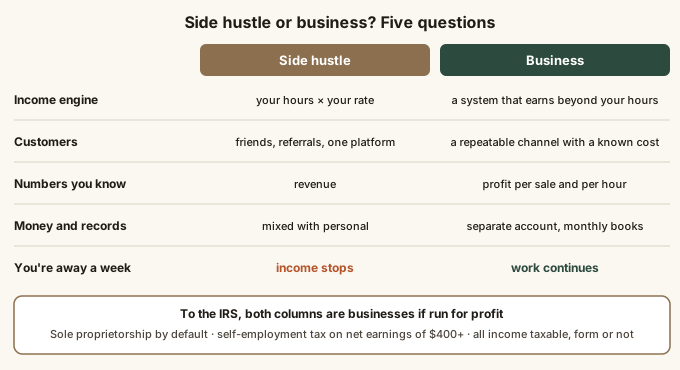
Legally, a side hustle done to make a profit is already a business: in the US it is a sole proprietorship by default, its net earnings over $400 owe self-employment tax, and all income is taxable whether or not a payment app sends a form. The IRS separates businesses from hobbies by profit motive, not by size. The practical difference is about how the income is produced. A side hustle typically trades your own hours for money, so income stops when you stop. A business has a system that can earn beyond your hours: repeatable customer acquisition, known unit economics, separate finances and records, and work that others or tools can do. Many side hustles are fine staying side hustles. The useful test is your true hourly profit after costs and taxes, and whether the work could run for a week without you.
Reading time
— 5 min
Updated
— Oct 8, 2026
Fact-reviewed
— Oct 8, 2026
Key Takeaways
Key Takeaways
1Legally, a side hustle run for profit is already a business. In the US it's a sole proprietorship by default, and its net earnings over $400 owe self-employment tax.
2The practical difference is the engine. A side hustle sells your hours, so income stops when you stop. A business has a system that earns beyond your hours.
3Test yours with two numbers: true hourly profit after costs and taxes, and whether it could run for a week without you. Staying a side hustle is a fine choice if you make it on purpose.
The concept
Picture two people who both bake cakes on weekends. The first takes orders from friends, bakes every one herself and gets paid per cake. If she takes a month off, the money stops. The second has a simple website that brings in orders every week, knows exactly what each cake costs to make, keeps a separate bank account, and has trained a helper who bakes the standard orders. If she takes a month off, cakes still go out. Both are earning money, and both, in the eyes of the tax office, are running a business. But only the second has built something that works without her hands on every cake. That's the real line between a side hustle and a business. It isn't about size, a fancy name or registering a company. It's about whether you've built a system or are selling your time. Neither is better. A side hustle is a perfectly good way to earn extra money. It's just worth knowing which one you have, because they need to be managed differently.
The tax details above are federal and current as of October 2026; states add their own rules, and the IRS's self-employment guidance is the place to check current thresholds.
Quick check
You earn $3,000 a year tutoring for profit, with no registration. What are you in the eyes of the IRS?
Worked examples
The people and figures below are hypothetical, chosen to show the arithmetic. Tax amounts are simplified federal estimates that ignore income tax and state rules.
Example 1: The freelance designer (baseline case)
Dev designs logos on evenings and weekends: $1,500 a month for about 30 hours of work, so $50 an hour on paper. Over a year that's $18,000 of net earnings, and self-employment tax is about $18,000 × 0.9235 × 0.153 ≈ $2,543, before income tax. Every dollar depends on his hours, and every client came through a friend. It's a healthy side hustle, and it's still a business for tax purposes, so he needs to set money aside and may need to make quarterly estimated payments.
Example 2: The busy online shop (edge case)
Priya sells handmade candles online: $24,000 in sales, which sounds like a real business. But materials, platform fees, shipping and ads cost $15,000, and the shop took about 600 hours. Profit is $9,000, or $15 an hour before self-employment and income tax. Revenue looks like a business; the economics look like a low-paid job. Knowing her margin per candle is the first step to deciding whether to raise prices, cut costs or stop.
Example 3: Crossing the line (applied)
Sam runs weekend house-cleaning. He writes a checklist for each job type, hires a part-time cleaner at $22 an hour, charges $45 an hour of cleaning, and puts $200 a month into local search ads that reliably bring in four new regular clients. Each cleaner-hour now leaves about $23 before other costs, and that profit arrives whether or not Sam is holding the mop. He opens a separate bank account and tracks income and expenses monthly. His hours went down and his income stayed the same. That's the shift from side hustle to business: a repeatable way to find customers, known unit economics, and work that doesn't require him personally.
Quick check
Which change does most to turn a side hustle into a business?
How it works (visual)
Side hustle vs business: five questions that show the difference
Common mistakes
Common Mistakes
✕
Ignoring taxes because 'it's just a side hustle'.
→ Set aside a share of every payment for self-employment and income tax, and check the IRS gig economy tax center for estimated-payment rules.
✕
Judging success by revenue.
→ Work out profit per hour after all costs. High sales can hide a low hourly wage.
✕
Mixing business and personal money.
→ Open a separate account and log every expense. It makes deductions defensible and shows whether you're actually profitable.
✕
Forming an LLC as the first step.
→ First prove people will pay repeatedly. Choose a structure when liability or scale makes it worthwhile, using the SBA's comparison.
Common misconception
“A side hustle isn't a real business until you register a company.”
To the IRS, if you're doing it for profit, it's a business from the first sale, taxed as a sole proprietorship by default. Registering an LLC changes liability and paperwork, not whether you're in business. What separates a side hustle from a scalable business is the income engine, not the legal form.
What to do next
What to do next
Total last year's side income and costs, then divide profit by hours worked to get your true hourly rate.
Open a separate bank account for the work and start a simple monthly income-and-expense log.
Read the IRS hobby-versus-business factors and the gig economy tax center pages.
Write down where your last ten customers came from. If it's mostly friends, test one repeatable channel.
Decide on purpose: keep it a time-for-money side hustle, or document one process someone else could do.
For your own tax situation, talk to a tax professional or a free SCORE mentor.
FAQ
FAQ
Related terms
Related terms
Side hustle
Informal term for paid work done alongside a main job, usually freelancing, gig work or selling products, typically depending on the owner's own hours.
Sole proprietorship
The default US business structure for one person doing business for profit without forming an entity. The owner and the business are legally the same, including for debts.
Self-employment tax
The Social Security and Medicare tax self-employed people pay on net earnings, 15.3% on most earnings, due once net self-employment earnings reach $400 in a year.
Hobby (tax)
An activity not engaged in for profit. Hobby income is still taxable, but hobby expenses generally can't be deducted under current federal rules.
Unit economics
The revenue and costs tied to one sale or one customer, which show whether each additional sale makes or loses money.
Customer acquisition
How a business finds and wins new customers, and what each new customer costs in money and time.
This entry was researched from public sources and drafted with AI-assisted tools, then edited — errors are still possible. Spot one, or want a topic covered? Read our disclaimer.
 KnowThis