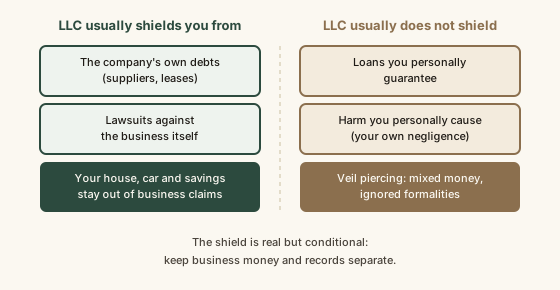
A limited liability company (LLC) is a separate legal entity formed under state law, and its main feature, per the U.S. Small Business Administration, is that owners are generally not personally liable for the company's debts and liabilities, so a creditor or lawsuit against the business can usually reach only business assets. That protection has real limits: owners remain liable for obligations they personally guarantee (common with small-business loans and leases), for harm they personally cause, and for unpaid payroll taxes in some cases, and courts can 'pierce the veil' and reach owners' personal assets when business and personal affairs are mixed or the entity was used to commit fraud, per Cornell Law School's Legal Information Institute. An LLC also doesn't change taxes by itself: by default the IRS treats a single-member LLC as a disregarded entity and a multi-member LLC as a partnership. This is general information, not legal advice; state laws differ.
Reading time
— 4 min
Updated
— Sep 25, 2026
Fact-reviewed
— Sep 25, 2026
Key Takeaways
Key Takeaways
1An LLC is a separate legal entity, so the business's own debts and lawsuits generally can't reach your house, car, or personal savings.
2It doesn't cover debts you personally guarantee, harm you personally cause, or cases where a court ignores the LLC because business and personal money were mixed.
3An LLC doesn't lower taxes on its own. By default a one-owner LLC is taxed just like a sole proprietorship.
The concept
If you run a business in your own name, the business's debts are your debts. If it gets sued and loses, the other side can go after your savings. Forming an LLC creates a separate legal "person" that owns the business. Now, if the business owes money or loses a lawsuit, the claim is generally against the LLC and what it owns, not against you. That's the wall people are paying for. But the wall has doors in it. If you sign a loan saying "I'll pay if the business can't," you've opened one. If you personally hurt someone, you're still responsible. And if you treat the LLC's bank account like your own wallet, a judge can decide the wall was never real.
Your LLC can't pay a supplier invoice, and you never signed any personal guarantee. What can the supplier usually go after?
Worked examples
Example 1: The shield working as intended (baseline case)
A bakery LLC signs a two-year equipment rental in the company's name only, then closes after a year. The rental company can pursue the LLC for the remaining payments and collect from whatever the LLC owns, such as ovens and its bank balance. The owner's personal home and retirement savings aren't part of that claim. This is limited liability doing exactly its job.
Example 2: The loan with a personal guarantee (the common gap)
The same owner took a $40,000 bank loan for the LLC. Like most banks lending to a new small business, the bank required the owner's personal guarantee. When the bakery closes with $25,000 still owed, the bank can collect that from the owner personally. The LLC didn't fail here. The owner signed away its protection for this one debt, which is why reading what you sign matters more than the entity type.
Example 3: The mixed-up bank account (veil piercing)
A contractor runs a one-person LLC but pays their mortgage and groceries from the business account, never keeps records separating the two, and leaves almost no money in the company. A customer wins a large judgment over bad work and finds the LLC empty. A court looking at these facts may decide the LLC was just the owner under another name and let the customer collect personally. Cornell LII lists commingling and undercapitalization among the classic reasons courts pierce the veil.
Quick check
In Example 3, what most weakened the contractor's LLC protection?
How it works (visual)
What an LLC usually shields, and where the shield stops
Common mistakes
Common Mistakes
✕
Paying personal expenses from the LLC's bank account.
→ Keep a separate business account and pay yourself through documented owner draws or salary. Separation is what makes the shield hold up.
✕
Assuming the LLC protects you on every business loan.
→ Check for personal guarantee language before signing. If it's there, that debt is yours too.
✕
Forming an LLC expecting a tax cut.
→ By default, a one-owner LLC is taxed like a sole proprietorship. Tax changes only come from elections like S corporation status, which have their own rules.
Common misconception
“Once you have an LLC, nothing that goes wrong in the business can touch your personal assets.”
The SBA describes LLC protection as applying "in most cases," and the exceptions are common in small businesses. Personal guarantees on loans and leases, your own negligent acts, some unpaid payroll taxes, and veil piercing when finances are mixed can all reach personal assets. An LLC is a strong tool when it's run as a genuinely separate business, backed by adequate insurance, not a force field.
What to do next
What to do next
Open a business bank account in the LLC's name and run every business transaction through it.
Sign contracts as the LLC ("Company Name, LLC, by Your Name, Member"), not in your personal name.
Before signing any loan or lease, look for personal guarantee language and understand what it means.
Keep the state filings current (annual reports, registered agent) and get general liability insurance appropriate to your work.
For a specific situation, talk to a business attorney or accountant in your state.
FAQ
FAQ
Related terms
Related terms
LLC (limited liability company)
A business structure created under state law that is legally separate from its owners (called members), combining limited liability with flexible tax treatment.
Limited liability
The rule that an owner's losses from the business's debts and lawsuits are generally limited to what they invested in it, keeping personal assets like a home or savings out of reach.
Piercing the corporate veil
A court decision to disregard a company's separate existence and hold its owners personally liable, usually because they mixed funds, ignored formalities, undercapitalized the business, or used it for fraud.
Personal guarantee
A signed promise by an owner to repay a business debt personally if the business can't. It overrides the LLC's liability shield for that debt.
Disregarded entity
The IRS's default classification for a single-member LLC: the business isn't taxed separately, and its profit or loss goes on the owner's personal return.
This entry was researched from public sources and drafted with AI-assisted tools, then edited — errors are still possible. Spot one, or want a topic covered? Read our disclaimer.
 KnowThis