 KnowThis
Key Takeaways
Key Takeaways
- 1Business registration generally involves three distinct documents: state-level formation paperwork (like articles of organization), a federal EIN from the IRS, and separately, any needed industry or local licenses/permits.
- 2The legal business structure chosen at formation — sole proprietorship, LLC, corporation, and others — affects liability, taxation, and paperwork requirements going forward, and switching structures later usually means starting a new registration process, not just editing the old one.
- 3This is general documentation literacy, not legal or tax advice for a specific business — an attorney or accountant familiar with your state and industry is the right resource for choosing a structure or confirming requirements.
The concept
Treating these three document types as a fixed sequence — structure first, then federal tax ID, then licenses/permits — is generally the most reliable order, since later steps often require the earlier ones to already exist.
Why is choosing a business's legal structure usually the first documentation step, before applying for an EIN?
Worked examples
Example 1: Forming a single-member LLC (baseline case)
Example 2: A business requiring an industry-specific license (edge case / variation)
Example 3: Operating without required registration (real-world / applied case)
What is a key practical consequence of forming an LLC or corporation rather than operating as an unregistered sole proprietor?
How it works (visual)
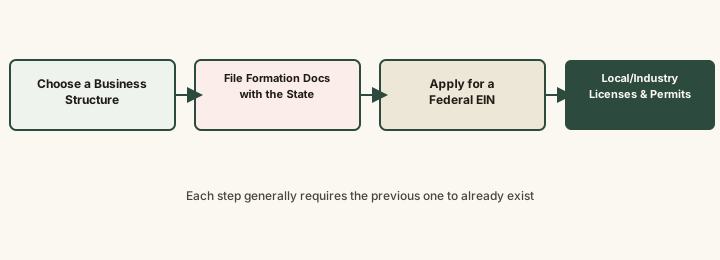
Each step generally depends on the one before it existing already — which is why skipping ahead (like trying to get a local license before the business is even formed) often runs into a documentation dead end.
Common mistakes
Common Mistakes
Assuming an EIN and a business's legal formation are the same step.
→ Treat them as separate, sequential documents — the state-level formation paperwork generally needs to exist before applying for a federal EIN.
Overlooking industry-specific or local licensing requirements beyond the base business registration.
→ Check with your local city/county government and any relevant industry regulator for additional license or permit requirements specific to your business type and location.
Operating informally for an extended period without completing formal registration.
→ Complete formal registration before conducting significant business activity, since the legal protections and tax treatment tied to a formal structure generally only apply once the paperwork is actually filed.
Common misconception
“Getting a business license from the city automatically means the business is also properly registered with the state and has a federal tax ID.”
A local business license is generally a separate document from state-level formation paperwork and a federal EIN — a business can hold a valid local license without having completed state formation, or vice versa. Each document serves a distinct legal or administrative purpose and is typically issued by a different level of government, so having one doesn't confirm the others are also in place.
What to do next
What to do next
- Research which legal business structure fits your situation, ideally with input from an attorney or accountant familiar with your state and industry.
- File the required formation documents with your state's Secretary of State (or equivalent) office before applying for a federal EIN.
- Check with your local city/county government and any relevant industry regulator for additional license or permit requirements.
- Keep copies of every registration document — formation paperwork, EIN confirmation, and any licenses — in a single accessible place for future reference.