 KnowThis
Key Takeaways
Key Takeaways
- 1Voter registration is a distinct administrative step from voting itself — it confirms eligibility and links your identity to a specific jurisdiction's voter roll before an election.
- 2Registration deadlines are typically separate from and earlier than election day itself, and requirements (proof of identity, proof of residence, timing) vary significantly by state and country.
- 3This is general civic process literacy, not a substitute for checking your specific jurisdiction's official election authority for exact deadlines and requirements where you live.
The concept
The distinction between registering and voting is the most important thing to internalize — treating them as the same step is the most common reason an otherwise-eligible person ends up unable to vote.
Why can someone who is fully eligible to vote still be turned away at the polls?
Worked examples
Example 1: Registering for the first time (baseline case)
Example 2: Moving to a new address before an election (edge case / variation)
Example 3: Missing a registration deadline (real-world / applied case)
Someone moves to a new state two months before an election. What should they check first regarding voter registration?
How it works (visual)
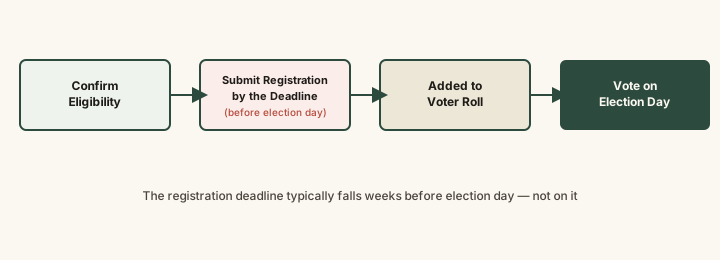
The gap between the registration deadline and election day is the part most often overlooked — treating registration as something that can be handled at the last minute, alongside voting itself, is the most common way an eligible person misses their chance to vote in a given election.
Common mistakes
Common Mistakes
Assuming voter registration and voting happen on the same day or as one combined step.
→ Check your specific jurisdiction's registration deadline separately — in most places it falls well before election day, though a growing number of jurisdictions do offer same-day registration.
Forgetting to update voter registration after moving to a new address, even within the same state.
→ Update your voter registration whenever you move, since your roll entry is tied to a specific address and precinct, not just your identity generally.
Assuming registration requirements are identical everywhere.
→ Check your specific state or country's official election authority, since required documentation and deadlines vary meaningfully by jurisdiction.
Common misconception
“If you're eligible to vote (of age, a citizen, a resident), you're automatically able to vote without any separate registration step.”
In most U.S. states and many countries, eligibility and registration are separate: an eligible person must still complete a registration application, by its own deadline, before their name appears on the voter roll checked at the polls. A small and growing number of jurisdictions offer automatic or same-day registration, but this isn't universal, which is why checking your specific jurisdiction's rules directly matters.
What to do next
What to do next
- Check your current voter registration status and your specific jurisdiction's registration deadline for any upcoming election.
- If you've moved recently, update your voter registration to your new address rather than assuming it carries over automatically.
- Gather whatever proof of identity and residence your jurisdiction requires before starting the registration application.
- Use your official state or national election authority's website (not a third-party site) to register or check your status, to ensure the information is authoritative and current.