 KnowThis
Key Takeaways
Key Takeaways
- 1The exact same set of ballots can produce a different winner depending on which counting method is used — the voting system itself is not a neutral formality.
- 2First-past-the-post can elect a winner with well under 50% of the vote if several candidates split the rest; proportional representation and ranked-choice voting are both explicitly designed to avoid that outcome, in different ways.
- 3Most countries use some blend of these systems rather than a single pure method — understanding the three base types lets you decode almost any real-world variant.
The concept
None of these systems is objectively "correct" — each trades off differently between simplicity, proportionality, and the strength of the resulting government, which is why democracies genuinely disagree about which to use.
In a first-past-the-post district, Candidate A gets 35% of the vote, Candidate B gets 33%, and Candidate C gets 32%. Who wins the seat?
Worked examples
Example 1: First-past-the-post with vote-splitting (baseline case)
Example 2: The same election under ranked-choice voting (edge case / variation)
Example 3: Proportional representation allocating seats to vote share (real-world / applied case)
Under proportional representation, Party Y wins 45% of the vote in a 100-seat legislature but doesn't reach the 51 seats needed for a majority. What typically happens next?
How it works (visual)
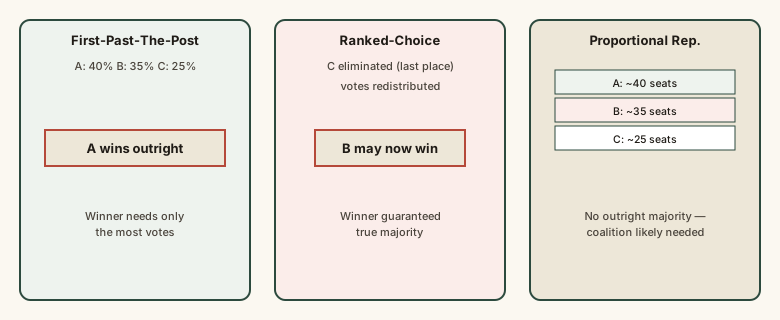
The identical starting vote count produces three structurally different results — this is the clearest demonstration that a voting system is a design choice with real consequences, not a neutral counting mechanism.
Common mistakes
Common Mistakes
Assuming the candidate or party with the most votes always ends up with a majority of power.
→ Check which voting system was used — under first-past-the-post and proportional representation alike, a plurality (most votes, but under 50%) frequently governs, or requires a coalition, rather than automatically becoming a full majority.
Treating ranked-choice voting as the same thing as proportional representation.
→ Ranked-choice voting is still a single-winner system with elimination rounds; proportional representation is a multi-seat system that allocates seats to parties by vote share. They solve different problems and aren't interchangeable terms.
Assuming every country uses the same voting system.
→ Voting systems vary widely and many countries blend multiple methods (like Germany's mixed-member proportional system) — always check which specific system applies before assuming how an election's result was determined.
Common misconception
“Whichever candidate or party gets the single most votes always ends up in charge.”
This is only guaranteed under a pure majority system. Under first-past-the-post, a plurality winner (most votes, not a majority) governs outright in that seat. Under proportional representation, the largest party frequently still needs coalition partners to reach a working majority of seats, since winning the most votes nationally rarely means winning over 50% of them.
What to do next
What to do next
- Before interpreting any election result, check which voting system was used — the same votes can mean different things under different systems.
- Notice when news coverage says a party 'won' — check whether that means an outright majority or just the largest single share.
- Look up your own country's or region's specific voting system to understand how your vote is actually counted and converted into representation.