 KnowThis
Key Takeaways
Key Takeaways
- 1The three branches differ along three concrete axes: what function they perform, how their members get the job, and how long they typically stay in it.
- 2The legislative branch is almost always the largest and most directly elected; the judicial branch is almost always the smallest and least directly elected, often for life or a long fixed term specifically to insulate it from short-term political pressure.
- 3The executive branch sits in between — its head is elected (directly or via the legislature), but the vast machinery beneath that head (agencies, civil servants) is appointed, not elected.
The concept
The length-of-term pattern isn't an accident — it maps directly onto how much insulation from short-term political pressure each branch is designed to have, with the judiciary getting the most insulation and the legislature getting the least.
Why do judges in most democracies serve much longer terms (or life appointments) compared to legislators, who typically serve just a few years at a time?
Worked examples
Example 1: Tracing one law through all three branches (baseline case)
Example 2: A parliamentary system blurring executive and legislative lines (edge case / variation)
Example 3: Why the executive branch is bigger than its elected head suggests (real-world / applied case)
After a national election, the president changes, but most government employees (tax office staff, park rangers, food inspectors) keep their jobs. Why?
How it works (visual)
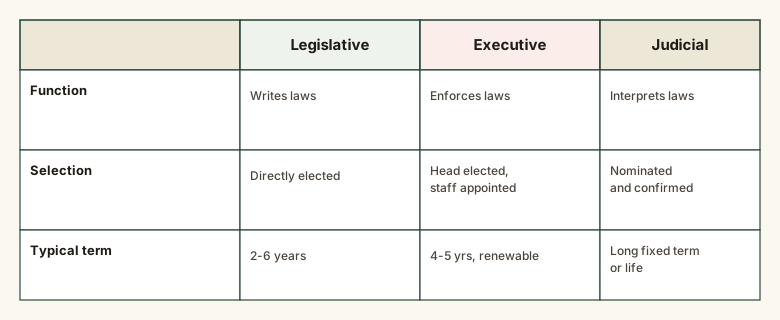
Reading down each column shows one branch's full profile; reading across each row shows how sharply the branches differ on that one dimension — the judiciary's row is the outlier on nearly every axis, which is exactly the intended design.
Common mistakes
Common Mistakes
Assuming the executive branch is just 'the president' or 'the prime minister' and nothing else.
→ Remember the executive branch includes the entire government administration beneath the elected head — agencies, departments, and a permanent civil service, most of which isn't elected or replaced by elections at all.
Assuming judges are elected the same way legislators are.
→ In most democracies, judges are nominated and confirmed (often by the executive and legislature working together), not directly elected — this is deliberate insulation from short-term political pressure.
Treating a parliamentary prime minister and a presidential-system president as functionally identical.
→ A prime minister is drawn from and remains a member of the legislature; a president in a presidential system is separately elected and structurally outside the legislature — the degree of executive-legislative fusion differs meaningfully between the two.
Common misconception
“Government employees (civil servants) are political appointees who all get replaced when a new leader takes office.”
The overwhelming majority of executive-branch employees are career civil servants hired through merit-based processes, not political appointment — they keep their jobs across changes in elected leadership. Only a relatively small layer of senior political appointees (cabinet secretaries, agency heads, and similar) typically turns over with an election, which is what preserves institutional expertise and continuity in government operations.
What to do next
What to do next
- When you read about a government action, identify which branch actually performed it — writing a law, enforcing it, or ruling on it are three different things often conflated in casual conversation.
- Look up whether your own country uses direct judicial elections or a nomination-and-confirmation model — it changes how insulated your judiciary is from short-term politics.
- Notice the difference between an election changing 'the government' (the political leadership) versus changing the entire executive branch (it doesn't) — the permanent civil service continues underneath.