 KnowThis
Key Takeaways
Key Takeaways
- 1The real difference between federal and unitary systems isn't how much day-to-day power regions have — it's whether that power is constitutionally guaranteed (federal) or delegated and revocable (unitary).
- 2In a federal system, the central government cannot simply abolish a state's constitutional powers by ordinary legislation; in a unitary system, the central government generally can alter or revoke devolved regional powers.
- 3Devolution (as practiced in the UK, France, or Spain) can look a lot like federalism day to day, but remains structurally unitary because the center retains ultimate constitutional authority over what was devolved.
The concept
This distinction matters most when tension arises between levels of government — a federal system has clear constitutional rules for that conflict, while a unitary system's regions are ultimately negotiating from a position the center could, in theory, unwind.
A national government wants to permanently abolish a specific state's government and absorb its territory directly. In a genuine federal system, can it do this through an ordinary majority vote in the national legislature?
Worked examples
Example 1: A federal system's states keeping independent authority (baseline case)
Example 2: Devolution in a unitary state looking federal but remaining structurally different (edge case / variation)
Example 3: A unitary state without any regional devolution at all (real-world / applied case)
The Scottish Parliament has meaningful day-to-day control over health and education policy. Does this make the UK a federal system?
How it works (visual)
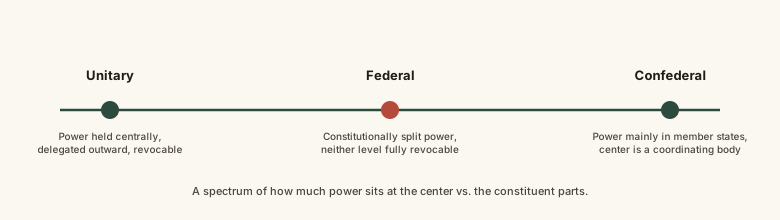
The spectrum runs from fully centralized to fully decentralized, with federalism occupying the genuinely split middle position — the key marker along this spectrum is always where constitutional authority originates, not how much day-to-day autonomy a region happens to exercise at any given moment.
Common mistakes
Common Mistakes
Judging whether a country is federal or unitary based on how much day-to-day autonomy its regions currently exercise.
→ Check whether that regional autonomy is constitutionally guaranteed and irrevocable by the center (federal) or delegated and revocable (unitary/devolved) — the amount of current autonomy alone doesn't settle the question.
Treating devolution and federalism as the same structural arrangement.
→ Devolution happens within a unitary state and remains revocable by the central government; federalism constitutionally locks in a state or province's authority in a way the national government cannot unilaterally undo.
Assuming all federal countries have identical power splits between national and state levels.
→ The specific balance of federal vs. state power varies enormously by country (the US, Germany, India, Brazil, and Australia are all federal but split power differently) — federalism describes a structural principle, not one fixed ratio.
Common misconception
“A country with strong, visible regional governments (states, provinces, devolved parliaments) must be a federal system.”
Visible, powerful regional government isn't proof of federalism — the UK's devolved administrations, France's regions, and Spain's autonomous communities all exercise real day-to-day authority within structurally unitary states. What actually defines federalism is whether that regional authority is constitutionally guaranteed and cannot be unilaterally revoked by the national government — a legal test, not a visual one.
What to do next
What to do next
- When assessing whether a country is federal or unitary, ask whether regional power is constitutionally guaranteed or delegated — not just how much autonomy currently exists.
- Look up your own country's structure and, if it has regional governments, check whether their powers come from the national constitution directly or from a devolution law that could in principle be altered.
- Notice news stories about central-vs-regional government disputes — they often hinge exactly on this federal-vs-unitary distinction, even when the terms themselves aren't used.