 KnowThis
Key Takeaways
Key Takeaways
- 1A constitution's defining trait is legal supremacy — it sits above ordinary law, so any regular statute that conflicts with it can be struck down by the courts.
- 2Constitutions are deliberately harder to change than ordinary laws, usually requiring supermajorities or referendums rather than a simple legislative vote — this difficulty is a design feature, not friction to be minimized.
- 3Not every country has a single written constitutional document — the United Kingdom and a few others rely on an 'uncodified' constitution built from multiple statutes, court rulings, and long-standing conventions instead.
The concept
The amendment-difficulty design shows up everywhere once you know to look for it — it's exactly why constitutional changes are rare, slow, and politically significant events compared to the routine business of passing ordinary legislation.
A legislature passes a law by a simple 51% majority vote. A citizen challenges it, arguing it conflicts with the constitution. What happens if a court agrees?
Worked examples
Example 1: An ordinary law struck down for conflicting with the constitution (baseline case)
Example 2: Why amending the constitution itself is a different, harder process (edge case / variation)
Example 3: An uncodified constitution still functioning as supreme law (real-world / applied case)
Why is a constitutional amendment process usually much harder to complete than passing an ordinary law?
How it works (visual)
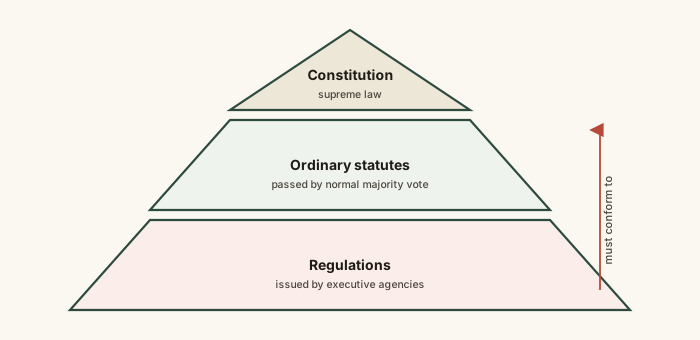
Each tier must conform to the one above it — regulations can't conflict with statutes, and statutes can't conflict with the constitution. This hierarchy, not any single document's content, is what makes a legal system "constitutional" in the structural sense.
Common mistakes
Common Mistakes
Assuming every country must have a single written constitutional document to have a functioning constitutional order.
→ Remember that a small number of countries (notably the UK) operate with an uncodified constitution built from multiple sources — what matters functionally is the supreme-law role, not the document format.
Assuming a law passed by a strong majority automatically overrides constitutional protections.
→ In a system with judicial review, no ordinary legislative majority, however large, can override the constitution without going through the harder formal amendment process.
Treating constitutional amendment and ordinary lawmaking as the same difficulty of process.
→ Amendment processes are deliberately harder (supermajorities, referendums, multi-stage ratification) than passing an ordinary statute — conflating the two misses why constitutions function as meaningfully stable, supreme law.
Common misconception
“A constitution is just a formal, mostly symbolic document that doesn't really constrain what a government can do in practice.”
In countries with real judicial review, a constitution has direct, enforceable legal force — courts routinely strike down laws and executive actions that conflict with it. Its symbolic weight is real, but so is its functional role as supreme law that ordinary legislation and administrative action must conform to, checked by an independent judiciary.
What to do next
What to do next
- When a law is struck down as 'unconstitutional,' recognize that means it conflicts with the supreme-law document, not simply that a judge personally disagreed with it.
- Look up your own country's amendment process and compare its threshold to the vote needed for an ordinary law — the gap tells you how well-protected your constitutional provisions actually are.
- Remember that having a written constitution and having genuine constitutional supremacy (real judicial enforcement) are two different things — some countries have both, some have neither in practice.