 KnowThis
Key Takeaways
Key Takeaways
- 1Fundamental rights are the specific rights written into a country's constitution — a legally enforceable subset of the much broader concept of human rights.
- 2The defining feature of a fundamental right isn't just that it's important — it's that it typically can't be removed by an ordinary majority vote in the legislature, unlike a regular statute.
- 3Courts enforce fundamental rights through judicial review: a law or government action that violates a protected right can be struck down, even if it passed through the normal lawmaking process.
The concept
Understanding fundamental rights starts with recognizing what makes them structurally different from any other law on the books — not their subject matter, but how hard they are to remove.
A legislature passes an ordinary law banning a specific type of public protest. A constitution in the same country guarantees a fundamental right to peaceful assembly. What happens?
Worked examples
Example 1: An ordinary law vs. a fundamental right (baseline case)
Example 2: A right that gets balanced, not absolute (edge case / variation)
Example 3: Emergency derogation with legal limits (real-world / applied case)
During a declared emergency, a government indefinitely suspends the right to a fair trial with no review process and no end date specified. What's the constitutional problem with this, even if some derogation is legally permitted?
How it works (visual)
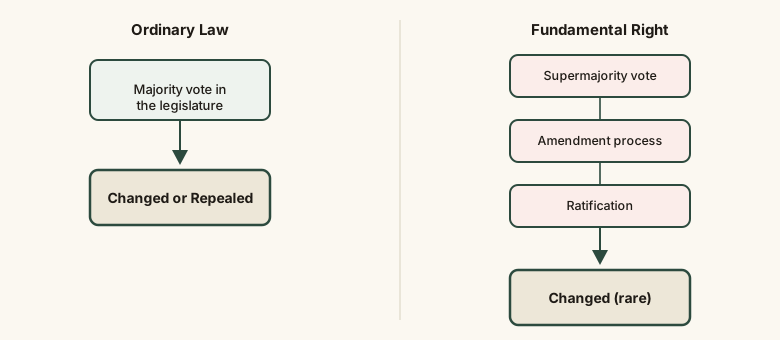
The diagram captures the entire practical difference in one image: an ordinary law can be undone in a single step, while a fundamental right sits behind a much taller, deliberately harder staircase of procedural hurdles — which is precisely what makes it "fundamental" rather than just "important."
Common mistakes
Common Mistakes
Assuming any right you feel strongly about is automatically a 'fundamental right' in the legal sense.
→ Check whether the specific right is actually enumerated in your constitution or established through binding case law — not every important-sounding entitlement carries constitutional protection.
Treating fundamental rights as absolute and unlimited under all circumstances.
→ Recognize that courts routinely balance fundamental rights against narrowly defined, compelling government interests — the right sets a high bar for restriction, not a zero-restriction rule.
Assuming a government declaring an 'emergency' automatically legalizes any suspension of rights.
→ Remember that legitimate derogation is itself legally constrained by proportionality, time limits, and review — an emergency declaration alone doesn't erase those constraints.
Common misconception
“Fundamental rights and human rights are just two names for the exact same thing.”
Human rights is the broader, universal moral and international-law concept — the idea that certain protections belong to every person simply by being human, regardless of what any particular country's law says. Fundamental rights is the narrower, country-specific legal category: the subset of rights a particular constitution has chosen to write down and make enforceable in its own domestic courts. A right can be recognized as a human right internationally without being enshrined as a fundamental right in every country's own constitution, and vice versa.
A right is widely recognized internationally as a human right but is not written into a particular country's constitution. What does this mean for someone in that country?
What to do next
What to do next
- Look up which specific rights are enumerated as fundamental in your own country's constitution — the list is usually shorter and more specific than most people assume.
- Next time you hear a rights-related news story, ask whether the dispute is about a fundamental (constitutional) right or an ordinary policy or statutory entitlement — the legal stakes differ significantly.
- Learn your country's specific amendment process for its constitution — that process is the real-world 'staircase' that makes a fundamental right hard to remove.
- If you want the international framing alongside the domestic one, read the Universal Declaration of Human Rights directly rather than relying on secondhand summaries.