 KnowThis
Key Takeaways
Key Takeaways
- 1Civic duties are the obligations side of citizenship, paired with the rights side — most political philosophy treats them as two halves of the same relationship between a citizen and their community.
- 2Some civic duties are legally mandatory and enforceable (paying taxes, jury service, compulsory military registration in some countries), while others are strongly expected but carry no legal penalty (voting, in most democracies).
- 3Compulsory voting, used by a minority of countries, is the clearest example of a civic duty that some governments have chosen to convert from expectation into legal requirement.
The concept
The practical value of separating civic duties into "legally required" and "socially expected" is that it tells you exactly what happens if you skip one — a real legal consequence, or just social/civic disapproval with no enforcement mechanism.
A citizen decides not to vote in an election in a country where voting is not compulsory. What are the legal consequences?
Worked examples
Example 1: A legally mandatory duty (baseline case)
Example 2: A duty that shifts between expected and mandatory depending on the country (edge case / variation)
Example 3: The rights-duties pairing in practice (real-world / applied case)
Why is the pairing of rights and duties often described as reciprocal rather than one-directional?
How it works (visual)
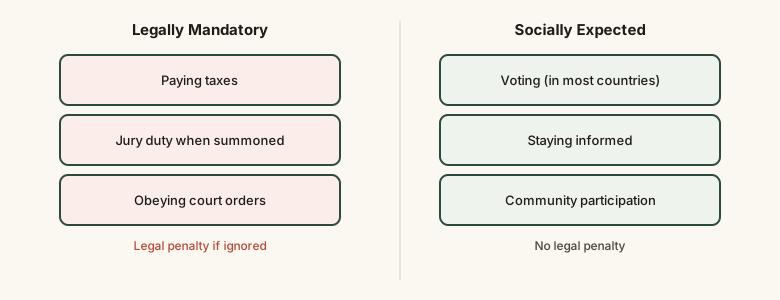
The two columns aren't separated by importance — voting is arguably as important to a functioning democracy as any legally mandatory duty — they're separated strictly by enforcement mechanism: one side has a legal penalty attached, the other relies entirely on social expectation.
Common mistakes
Common Mistakes
Assuming all civic duties carry the same legal weight as jury duty or taxes.
→ Check whether a given duty is legally enforced or only socially expected in your specific country — the distinction changes what actually happens if it's skipped.
Assuming voting is legally compulsory everywhere, or assuming it's legally compulsory nowhere.
→ Look up your own country's specific rule — compulsory voting exists in a minority of countries (Australia and Belgium among them), while most leave it as an expectation only.
Treating rights and duties as unrelated categories.
→ Remember the reciprocal framing: the services and protections that make rights meaningful (courts, public infrastructure, security) are themselves sustained by citizens fulfilling their duties.
Common misconception
“If a civic duty isn't backed by a legal penalty, it isn't a 'real' duty at all.”
Legal enforceability isn't the only thing that makes an obligation real — many of the most consequential civic duties, like voting and staying informed, function entirely through social expectation rather than legal compulsion in most democracies, yet political scientists and constitutional documents alike still treat them as genuine duties. The absence of a fine doesn't mean the absence of an obligation; it just means the obligation is enforced socially and civically rather than through the courts.
What to do next
What to do next
- Look up whether your own country treats voting as legally compulsory or socially expected — the answer varies more than most people assume.
- If you receive a jury summons, treat it as a legal obligation, not an optional invitation — ignoring it without a valid exemption carries real legal consequences in most jurisdictions.
- Read Article 29 of the Universal Declaration of Human Rights for the formal international framing of duties alongside rights.
- Next time you think about your rights as a citizen, pair the thought with the specific duties that help sustain the system that protects those rights.