 KnowThis
Key Takeaways
Key Takeaways
- 1Taxes work as a pooling mechanism: many individually modest, mandatory contributions combine into a single budget large enough to fund things no household could buy alone, like a national highway system or a standing military.
- 2Public goods — services that are hard to exclude anyone from and don't run out with use, like street lighting or basic law enforcement — are the core economic reason taxation exists rather than pure individual purchasing.
- 3Progressive taxation, where the tax rate rises with income, is one specific design choice about how the pooling burden is distributed — not an inherent feature of taxation itself.
The concept
Once you see taxation as a pooling mechanism for goods that are hard to fund individually, most of the specific policy debates (what to tax, how progressive to make it, what to spend it on) become questions about design choices layered on top of that basic mechanism, not about whether pooling itself makes sense.
Why can't street lighting realistically be funded through voluntary individual payments the way a private gym membership is?
Worked examples
Example 1: Calculating a simple flat tax owed (baseline case)
Example 2: A progressive system where different income bands face different rates (edge case / variation)
Example 3: Pooling at national scale (real-world / applied case)
Under a progressive tax with a 10% rate on the first $20,000 and 25% above that, why doesn't someone earning $50,000 simply pay 25% on the entire $50,000?
How it works (visual)
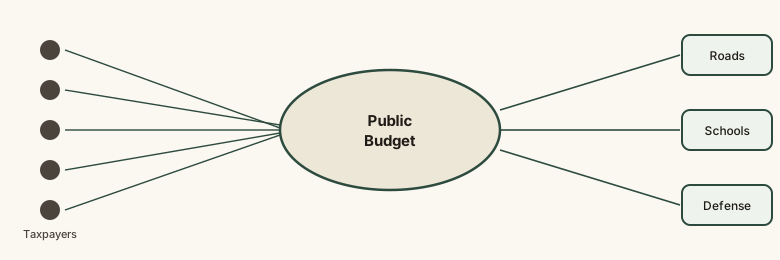
The diagram makes the mechanism concrete: contributions flow in from many individually modest sources, combine into one shared pool, and flow back out toward services that no single contribution could have funded on its own.
Common mistakes
Common Mistakes
Assuming a progressive tax bracket's top rate applies to your entire income, not just the income within that band.
→ Remember that bracket-based systems tax each slice of income at that slice's rate — only the amount above a threshold is taxed at the higher rate, not the whole income.
Treating all taxes as equally progressive.
→ Recognize that different tax types (income, sales, property) have different progressivity profiles — sales taxes in particular tend to be closer to flat or regressive in practice.
Assuming public services could just as easily be funded through voluntary individual payments instead of taxation.
→ Consider whether the service is a public good (non-excludable, non-rival) — those specific properties are what make voluntary funding systematically under-collect compared to mandatory pooling.
Common misconception
“Moving into a higher tax bracket means your entire income gets taxed at the new, higher rate, so a raise could leave you with less money overall.”
This is one of the most persistent misunderstandings about progressive taxation. Only the portion of income that falls within the higher bracket is taxed at the higher rate — income in the lower brackets keeps being taxed at those lower rates. A raise that pushes part of your income into a new bracket will always result in more after-tax income overall, not less, because the higher rate only ever applies to the additional income above the threshold.
Someone worries that a raise pushing them into a higher tax bracket will leave them with less take-home pay than before the raise. Is this concern justified?
Try it yourself
What to do next
What to do next
- Look up your own country's tax brackets to see how the marginal-rate structure actually applies to your income level.
- Next time you hear a public service described as 'free,' mentally substitute 'funded through pooled taxation' — it clarifies where the money actually comes from.
- Identify one public good near you (street lighting, a public park) and consider why it would be hard to fund through voluntary individual payment alone.
- Use the calculator above with your own numbers to see the mechanical relationship between a tax rate and the amount owed.