 KnowThis
Key Takeaways
Key Takeaways
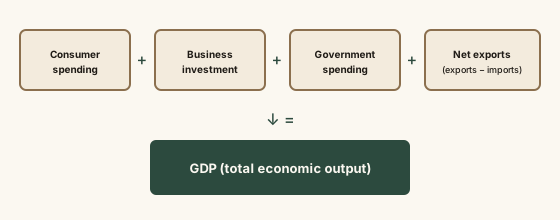
- 1GDP adds up consumer spending, business investment, government spending, and net exports to measure total economic output in a period.
- 2Per the BEA, GDP measures the scale of production and economic activity — it doesn't directly measure well-being, income distribution, or unpaid work.
- 3Real GDP adjusts for inflation, making it possible to compare economic output across different time periods on a like-for-like basis.
GDP at a glance
| Question | Answer |
|---|---|
| Formula | Consumer spending + business investment + government spending + (exports minus imports) |
| What counts | Final goods and services sold in markets, produced within the country's borders |
| What's left out | Unpaid work such as caregiving, how income is shared, and well-being itself |
| Who publishes U.S. GDP | The Bureau of Economic Analysis (BEA) |
| How often | Quarterly and yearly; each quarter is estimated three times (advance, second, third), so a new release comes out most months |
The concept
This is also why economists typically look at GDP alongside other measures — like median income, unemployment, and inflation — rather than treating it as a single all-purpose scorecard for how an economy is actually serving its population.
A country's GDP grows 4% in a year, but median household income stays roughly flat. What does this combination most directly indicate?
Worked examples
Example 1: Adding up the four components (baseline case)
Example 2: Nominal versus real GDP during high inflation (edge case / variation)
Example 3: Unpaid work outside GDP (real-world / applied case)
Why does a parent leaving paid work to provide childcare at home reduce measured GDP, even though the same amount of care work is still being done?
How it works (visual)
Common mistakes
Common Mistakes
Treating GDP growth as automatic proof that typical living conditions are improving.
→ Check GDP alongside other measures like median income and unemployment, since GDP doesn't directly measure distribution or well-being.
Comparing nominal GDP across years without adjusting for inflation.
→ Use real GDP for any comparison across time periods, since it removes the distorting effect of price changes.
Assuming GDP captures all economically valuable activity.
→ Remember GDP excludes unpaid work like caregiving and informal exchanges, per BEA's own framing of what it measures.
Common misconception
“A rising GDP means the average person's financial situation is getting better.”
Per the BEA's own framing, GDP measures the total scale of economic production and activity — it does not directly measure how that output is distributed across a population, household well-being, or unpaid work. GDP can rise while median income stays flat or even falls, if growth is concentrated narrowly. This is exactly why economists pair GDP with other indicators, like median household income and unemployment, rather than treating it as a standalone measure of how typical people are actually faring.
What to do next
What to do next
- When reading a GDP report, check whether it's nominal or real (inflation-adjusted) — they tell different stories.
- Pair GDP figures with median income and unemployment data before drawing conclusions about typical living conditions.
- Remember GDP doesn't count unpaid work — it measures market-based production and activity specifically.
- Treat GDP as one economic indicator among several, not a complete scorecard for how an economy is serving its population.