 KnowThis
Key Takeaways
Key Takeaways
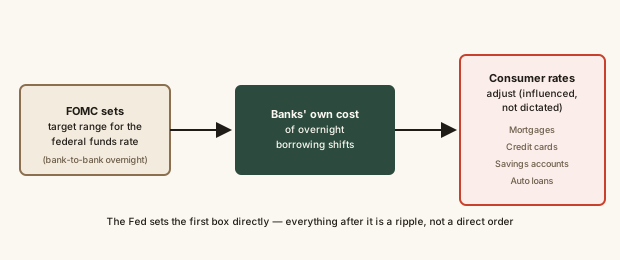
- 1The Federal Reserve doesn't set your mortgage, credit card, or savings rate directly — it sets a target range for the federal funds rate, the rate banks charge each other for overnight loans.
- 2That target ripples outward through the broader cost of borrowing and lending in the economy, influencing — not dictating — the rates banks offer on consumer and business products.
- 3Different products respond at different speeds: variable-rate products tied to a bank's prime rate can reprice within days, while a 30-year fixed mortgage already in place doesn't change at all.
The concept
This is also why a rate announcement doesn't touch every loan you already have. A fixed-rate loan is priced once, at origination — the rate is locked into the loan's terms and doesn't move with the Fed afterward. Only new originations, and existing variable-rate products that are explicitly tied to a moving benchmark, reprice when the underlying rate environment shifts.
News coverage says 'the Fed raised interest rates by a quarter point.' What did the Fed actually change?
Worked examples
Example 1: A quarter-point rate hike and a credit card (baseline case)
Example 2: The same hike and a 30-year fixed mortgage (edge case / variation)
Example 3: The same hike and a savings account (real-world / applied case)
Two banks face the same Fed rate hike. One raises its savings account APY within days; another barely moves its rate for months. What best explains this?
How it works (visual)
Common mistakes
Common Mistakes
Assuming the Fed sets your specific mortgage or credit card rate directly.
→ Understand the Fed sets a target for the rate banks charge each other overnight — your bank then sets its own consumer rates based on its own cost of funds and competitive position.
Expecting every rate you hold to move immediately after a Fed announcement.
→ Check whether your product is fixed or variable — fixed-rate loans already in place don't reprice; only new originations and rate-linked variable products respond, and not all at the same speed.
Treating a Fed rate move and a mortgage rate move as the same thing.
→ Recognize that long-term fixed mortgage rates track bond market yields and future rate expectations more than any single Fed meeting, so the two can even move in opposite directions.
Common misconception
“The Federal Reserve directly sets the interest rate on my mortgage, credit card, or savings account.”
Per the Fed's own description of its role, it sets a target range for the federal funds rate — the rate banks charge each other for overnight loans — and uses a small set of tools to keep the actual bank-to-bank rate inside that range. That change then ripples outward through the broader cost of borrowing and lending in the economy, influencing but not directly setting the rate any individual bank offers on any individual product. Your specific rate also reflects your own creditworthiness, the loan's term, and each lender's own competitive and funding decisions — several layers removed from the Fed's target itself.
See the ripple in numbers
Because consumer rates trace back to shifts in the broader cost of money, even a rate difference that sounds small compounds meaningfully over years on a balance. This calculator illustrates that compounding effect generally — it doesn't predict Fed policy or model any specific account or loan.
Illustrates why even a one- or two-percentage-point difference in a rate matters more the longer money sits at that rate — the same compounding math applies whether the balance is savings or debt.
Illustrative only. This is a general compounding calculation, not a projection of future Federal Reserve policy, a specific bank's rate, or your own account or loan terms.
What to do next
What to do next
- When you hear 'the Fed raised/cut rates,' recognize it's a target for bank-to-bank overnight lending, not your specific consumer rate.
- Check whether your loan or account is fixed or variable — only variable products tied to a moving benchmark reprice quickly.
- For a mortgage specifically, compare rate movement to longer-term bond yields and rate expectations, not just the most recent Fed meeting.
- This is general educational information about a mechanism, not a rate forecast or personalized financial advice — consult a licensed financial professional for decisions specific to your situation.