 KnowThis
Key Takeaways
Key Takeaways
- 1An installment loan's monthly payment is a direct mathematical function of three inputs: principal, interest rate, and term — change any one and the payment recalculates predictably.
- 2A longer term lowers the monthly payment by spreading principal over more payments, but it typically increases the total interest paid over the life of the loan, since interest keeps accruing on the outstanding balance for longer.
- 3Amortization means each payment is split between interest and principal, with the interest portion largest early in the loan (when the outstanding balance is highest) and smallest near the end.
The concept
Because the formula is fixed and mechanical, it's possible to see exactly how a loan changes shape by adjusting any one of its three inputs — which is what the calculator below does.
If a loan's term is doubled while the principal and interest rate stay the same, does the monthly payment get cut in half?
Worked examples
Example 1: A $20,000 loan at 6% over 5 years (baseline case)
Try it yourself
Example 2: The same $20,000 loan stretched to 7 years instead of 5 (edge case / variation)
Why does stretching a loan's term from 5 years to 7 years typically increase the total interest paid, even at the same interest rate?
Example 3: Comparing two lenders' offers on a $15,000 auto loan (real-world / applied case)
How it works (visual)
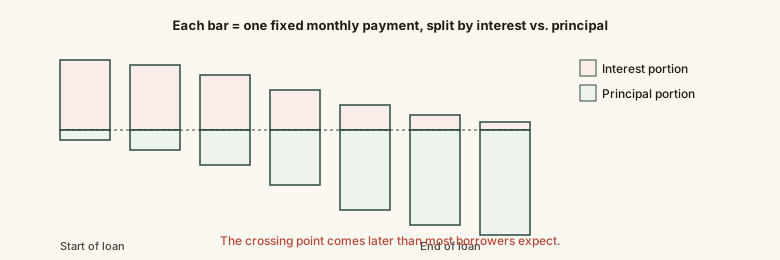
The visual crossing point — where the principal portion of the payment overtakes the interest portion — happens later in the loan than most borrowers expect, which is part of why paying off a loan early saves more interest than intuition suggests.
Common mistakes
Common Mistakes
Comparing loan offers by monthly payment alone rather than by rate, term, and total interest together.
→ Compare the APR and total interest paid across offers with the same principal and term, since a lower monthly payment can come from a longer term that costs more overall.
Assuming a longer loan term is a straightforward win because the monthly payment is lower.
→ Check the total interest paid figure, not just the monthly payment — a longer term almost always means more total interest at the same rate.
Believing early loan payments reduce the balance at the same rate as later payments.
→ Recognize that amortization front-loads interest — early payments are weighted more heavily toward interest, so the balance declines slower than a simple division might suggest.
Common misconception
“Halfway through a loan's term, you should have paid off roughly half the principal.”
Because of amortization, a fixed payment is split between interest and principal unevenly over time — early payments go disproportionately toward interest since the outstanding balance (and the interest charged on it) is highest at the start. On many common loan terms, the borrower has paid off meaningfully less than half the principal at the halfway point in time, even though half the payments have been made.
What to do next
What to do next
- Use the calculator above to compare how changing the term, rate, or principal on a loan you're considering reshapes both the monthly payment and total interest.
- When comparing offers from multiple lenders, hold the term and principal constant and compare the APR directly.
- Read any loan's amortization schedule, if provided, to see exactly how much of each payment goes to interest versus principal.
- For decisions about which specific loan or repayment strategy fits your situation, consult a financial advisor or a nonprofit credit counselor (such as one affiliated with the NFCC) rather than treating this article as personalized advice.