 KnowThis
Key Takeaways
Key Takeaways
- 1Interest only accrues on a carried balance — if the previous statement balance is paid in full by the due date, the grace period means no interest is charged on new purchases at all.
- 2APR is an annual rate divided down to a periodic rate (commonly daily) to calculate the actual dollar interest charge on whatever balance is carried.
- 3The minimum payment is calculated to keep the account current, not to pay off the balance efficiently — paying only the minimum can stretch repayment across many years and multiply the total interest paid.
The concept
The mechanical relationship between these three pieces — grace period, APR, minimum payment — determines almost everything about how expensive or cheap a given month of credit card use turns out to be.
If a cardholder pays their full statement balance every month without exception, do new purchases ever accrue interest?
Worked examples
Example 1: Carrying a $1,000 balance at 22% APR for one month (baseline case)
Try it yourself
Example 2: Losing the grace period by carrying a small balance (edge case / variation)
A cardholder pays $980 of a $1,000 statement balance, leaving $20 unpaid. What's the likely mechanical consequence for the next billing cycle's new purchases?
Example 3: Paying only the minimum on a $3,000 balance (real-world / applied case)
How it works (visual)
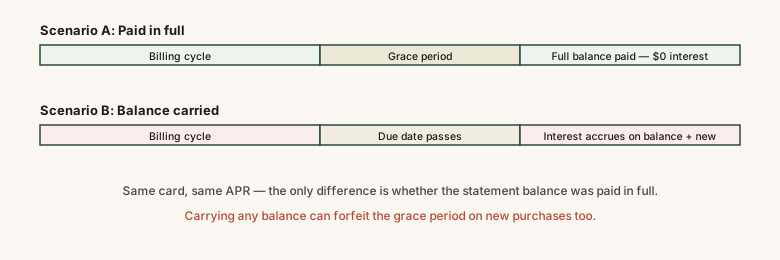
The visual difference between the two timelines is the entire financial cost of carrying a balance versus not — same card, same APR, dramatically different outcome.
Common mistakes
Common Mistakes
Assuming any partial payment preserves the interest-free grace period.
→ Check the cardholder agreement — many cards require the full statement balance to be paid to keep the grace period on new purchases the following cycle.
Treating the minimum payment as a reasonable target for paying down a balance.
→ Recognize the minimum payment is calculated to keep the account current, not to pay off debt efficiently — paying more than the minimum, when possible, reduces total interest paid substantially.
Comparing cards only by looking at their advertised APR without checking how interest is calculated (daily balance vs. average balance vs. other methods).
→ Read the cardholder agreement's interest calculation method, since two cards with the same advertised APR can produce different actual charges depending on the calculation method used.
Common misconception
“Making the minimum payment on time means you're handling the debt responsibly and it will be paid off in a reasonable timeframe.”
Making the minimum payment on time does keep the account in good standing and avoids late fees and default — but the minimum payment formula is designed around that compliance goal, not around efficient payoff. On a meaningful balance, paying only the calculated minimum each month can take years and result in substantial extra interest, a mechanical fact worth knowing even though it isn't a reason to panic about any single month's minimum payment.
What to do next
What to do next
- Check your cardholder agreement's exact grace period condition — most require paying the full statement balance, not just the minimum, to keep it.
- Use the calculator above with your own balance and APR to see the actual monthly dollar cost of carrying that balance.
- If you're carrying a balance you're unsure how to pay down, a nonprofit credit counseling agency affiliated with the National Foundation for Credit Counseling (NFCC) can review your specific situation for free or low cost — this is a factual resource, not personalized advice from this article.
- Don't treat the minimum payment amount as a target — treat it as the floor required to avoid penalties, not the goal.