A credit report is a detailed record of a person's borrowing and repayment history, compiled independently by each of three major credit bureaus from data voluntarily reported by lenders — it's the underlying data source that credit scores are calculated from, not the score itself.
Reading time
— 4 min
Updated
— Aug 22, 2026
Fact-reviewed
— Aug 22, 2026
Key Takeaways
Key Takeaways
1A credit report is the underlying data — account history, payment record, public records — that a credit score is calculated from; the report and the score are two different things.
2In the US, three separate companies (Equifax, Experian, TransUnion) each keep their own independent report, built from data voluntarily reported by lenders, not shared automatically between bureaus.
3Because reporting is voluntary and not perfectly synchronized, the same person's three reports can genuinely differ — one bureau might have information another doesn't yet.
The concept
A credit report is a written history of your credit accounts — credit cards, loans, mortgages — showing balances, credit limits, and whether payments were made on time. A credit bureau compiles this from information that banks, credit card companies, and other lenders send them. In the US there are three major bureaus, and each keeps its own separate report, so your report from one bureau isn't automatically identical to the others.
The gap between "credit report" and "credit score" is the single most common point of confusion in this whole system — the report is data, the score is a calculation performed on that data.
Quick check
Why might someone's credit report from Experian show a recently opened account that isn't yet listed on their TransUnion report?
Worked examples
Example 1: Pulling all three reports and finding a discrepancy (baseline case)
Someone requests all three free reports through AnnualCreditReport.com and notices their Equifax report lists a credit card with a $2,000 limit, but the same card shows a $1,800 limit on their TransUnion report. This is a realistic outcome of non-synchronized reporting — the lender likely updated the limit and reported the change to one bureau before the other, and it isn't automatically evidence of fraud or a report error requiring urgent correction, though it's still worth confirming with the lender directly if the discrepancy seems unusual.
Example 2: A hard inquiry from a mortgage pre-approval (edge case / variation)
Applying for mortgage pre-approval triggers a hard inquiry, which appears on the credit report and can cause a small, typically temporary score dip. Because rate-shopping for a single loan type (mortgage, auto) within a short window (commonly 14-45 days depending on the scoring model version) is usually counted as a single inquiry rather than several separate ones, comparing offers from multiple mortgage lenders within that window doesn't multiply the score impact the way applying for several unrelated credit cards in the same period would.
Quick check
Does shopping around for a mortgage by applying with five different lenders in the same week typically create five separate hard-inquiry penalties?
Example 3: Disputing an error found on a credit report (real-world / applied case)
A consumer finds an account on their report that isn't theirs — a possible sign of identity theft or simply a data-matching mix-up. Under the Fair Credit Reporting Act, they can file a dispute directly with the bureau reporting the error, which is legally required to investigate (typically within 30 days) and correct or remove information it can't verify as accurate. This dispute process is a real, structured legal mechanism, not an informal request — it exists because the law recognizes credit reports carry real financial consequences and errors need a defined path to correction.
How it works (visual)
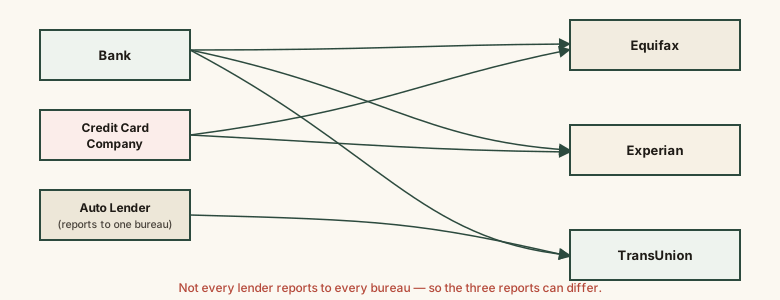
How data flows from lenders into three separate credit reports
Because each arrow represents an independent, voluntary reporting relationship rather than a single shared pipe, the three bureaus can each end up with a genuinely different snapshot of the same person's credit activity at any given moment.
Common mistakes
Common Mistakes
✕
Checking only one bureau's report and assuming it represents the complete picture.
→ Pull all three reports (free annually via AnnualCreditReport.com) since lenders may report to only one or two bureaus, leaving gaps in any single report.
✕
Confusing a 'credit report' with a 'credit score' as the same document.
→ Remember the report is the underlying data; the score is a separate number calculated from that data by a scoring model like FICO or VantageScore, and isn't automatically included on every free report.
✕
Assuming a discrepancy between two bureaus' reports always means fraud or an error requiring urgent action.
→ Recognize that non-synchronized voluntary reporting commonly produces minor differences between bureaus — verify with the lender before assuming something is wrong.
Common misconception
“There is one single, official 'credit report' that every lender sees the same version of.”
There are three separate, independently maintained reports (from Equifax, Experian, and TransUnion in the US), each built from whatever data lenders chose to report to that specific bureau. A lender pulling your "credit report" is pulling one bureau's version — possibly not all three — which is why decisions or scores can occasionally differ depending on which bureau a lender happens to use.
What to do next
What to do next
Request your free reports from all three bureaus through the official AnnualCreditReport.com — not a third-party site with a similar-sounding name.
Review each report for accounts you don't recognize, incorrect balances, or payment statuses that don't match your own records.
If you find an error, file a dispute directly with the bureau reporting it — this is a legal right under the Fair Credit Reporting Act, not an informal favor.
Don't assume a small difference between bureaus is automatically fraud — check with the specific lender first before escalating.
FAQ
FAQ
Related terms
Related terms
Credit report
A detailed record of a person's credit accounts, payment history, and public financial records, compiled by a credit bureau from data reported by lenders — the raw data a credit score is calculated from.
Credit bureau
A company (in the US, one of Equifax, Experian, or TransUnion) that collects, stores, and sells consumer credit data to lenders and generates credit reports.
Hard inquiry
A record created when a lender checks a credit report as part of an actual credit application, which can cause a small, temporary dip in a credit score — distinct from a soft inquiry, which has no score effect.
This entry was researched from public sources and drafted with AI-assisted tools, then edited — errors are still possible. Spot one, or want a topic covered? Read our disclaimer.
 KnowThis