How Financial Scams & Ponzi Schemes Work (Protective Literacy)
A Ponzi scheme is a fraud that pays purported returns to earlier investors using money from newer investors rather than from any actual profit-generating activity, meaning it requires an ever-growing base of new investors to survive and collapses once that growth can no longer outpace withdrawals.
Reading time
— 4 min
Updated
— Aug 22, 2026
Fact-reviewed
— Aug 22, 2026
Key Takeaways
Key Takeaways
1A Ponzi scheme pays supposed investment returns using money from newer investors, not from any real underlying investment activity — there's no actual profit being generated anywhere in the structure.
2Because payouts depend entirely on new money coming in, a Ponzi scheme requires an ever-growing base of new investors just to keep functioning — mathematically, it cannot continue indefinitely.
3The most reliable red flags, per the SEC and FTC, are consistently high returns with little or no risk regardless of market conditions, overly consistent returns, and unregistered or unlicensed sellers.
The concept
A Ponzi scheme is a fraud where the operator tells investors their money is earning returns through some investment strategy, but in reality there's no real investment happening — early investors are simply paid using money collected from later investors. It's named after Charles Ponzi, who ran a scheme in Boston in 1920 promising investors a 50% return in 45 days using international postal reply coupons, a business that couldn't actually generate anywhere near those returns at the scale he was running it.
Seeing the actual arithmetic behind why a Ponzi scheme is unsustainable makes the collapse feel inevitable rather than surprising, which is exactly the intuition that helps someone recognize one before investing.
Quick check
Why can't a Ponzi scheme simply continue forever if it keeps attracting some new investors every year?
Worked examples
Example 1: A simplified small-scale Ponzi cycle (baseline case)
Ten investors each put in $10,000, for $100,000 total. The operator promises 20% annual returns. To pay out $2,000 to each of the ten investors ($20,000 total) without any real investment activity, the operator needs $20,000 in new money from new investors that year alone — and that requirement grows every subsequent year as more "returns" accrue on paper for a larger and larger investor base.
Example 2: What happens when new investment slows (edge case / variation)
Continuing the example, suppose in year three new investment drops sharply — perhaps because of a broader economic downturn making people more cautious with their money generally. The operator now has existing "balances" showing tens of thousands of dollars in accumulated paper returns across many investors, but nowhere near that amount in real incoming cash. Any wave of investors trying to withdraw at once reveals the shortfall immediately, which is exactly the mechanism that exposed Madoff's scheme during the 2008 financial crisis, when a wave of redemption requests could no longer be covered by new investment.
Example 3: Recognizing a legitimate-sounding pitch using real red flags (real-world / applied case)
An investment pitch promises "consistent 15% monthly returns, no matter what the market does," is not registered with securities regulators, and pressures the investor to bring in friends and family for a referral bonus. Per SEC and FTC guidance, each one of these is an independently recognized red flag: real markets fluctuate, so genuinely uncorrelated, unusually smooth returns are a documented Ponzi hallmark; registration with securities regulators is a real, checkable fact (most legitimate investment sellers are registered, and this can be verified through a regulator's public database); and pressure to recruit new investors mirrors the exact mechanism that keeps a Ponzi or pyramid scheme's money flowing in.
Quick check
An investment opportunity claims steady, unusually high monthly returns regardless of what's happening in the broader market. Why does this specifically raise suspicion, according to regulators?
How it works (visual)
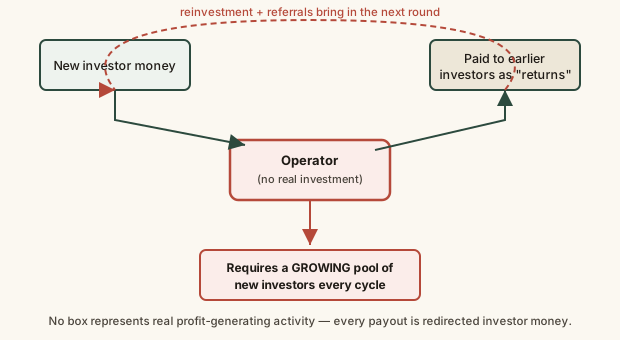
How money actually flows in a Ponzi scheme
The critical detail is what's missing from the diagram — there's no box anywhere representing real investment growth. Every dollar paid out as a "return" is simply redirected from a different investor's contribution, which is why the arrow requiring an ever-larger stream of new investors each cycle is the actual engine keeping the whole structure running.
Common mistakes
Common Mistakes
✕
Assuming a scheme can't be a scam because it has paid real returns to you or people you know so far.
→ Real payouts early on are exactly how a Ponzi scheme builds trust and encourages reinvestment and referrals — being paid successfully in the past doesn't rule out the structure being unsustainable long-term.
✕
Trusting an investment because it comes recommended by friends or family already invested in it.
→ Personal referrals are also the exact mechanism that fuels a Ponzi or pyramid scheme's growth — verify registration and real red flags independently rather than relying on a personal connection's endorsement.
✕
Assuming regulators would have already shut down any scheme that's been running for years.
→ Some real schemes, including Madoff's, ran for decades before discovery — longevity alone isn't evidence of legitimacy; check the specific, documented red flags instead.
Common misconception
“If an investment has consistently paid out real money to real people for years, it can't be a Ponzi scheme.”
A Ponzi scheme's entire mechanism depends on paying real money to earlier investors — that's precisely what keeps it running and attracting new investment. Years of consistent payouts reflect a scheme that hasn't yet run out of new money, not evidence that real profit-generating investment is occurring underneath it.
What to do next
What to do next
Verify any investment seller's registration status through your national securities regulator's public database before investing.
Be skeptical of any investment promising unusually consistent, high returns regardless of market conditions — real markets fluctuate, and genuine investments reflect that.
Treat pressure to recruit friends or family, or a referral-bonus structure, as a direct red flag, not just a marketing quirk.
If you suspect a scheme, report it to your national securities regulator or consumer protection agency — reporting early can limit how many additional investors are harmed.
FAQ
FAQ
Related terms
Related terms
Ponzi scheme
A fraud in which purported returns are paid to earlier investors using money collected from newer investors, rather than from any genuine profit-generating investment activity, named after Charles Ponzi's 1920 scheme.
Pyramid scheme
A fraud structurally similar to a Ponzi scheme, but one where existing participants are explicitly required to recruit new participants themselves in order to be paid, rather than a central operator managing all payouts.
If a savings account balance grows from $10,000 to $10,200 over a year (2% nominal growth), while inflation for that year was 4%, what happened to the real purchasing power of that money?
This entry was researched from public sources and drafted with AI-assisted tools, then edited — errors are still possible. Spot one, or want a topic covered? Read our disclaimer.
 KnowThis