 KnowThis
Key Takeaways
Key Takeaways
- 1A retirement account is a tax wrapper, not an investment itself — the account type determines how and when the money inside is taxed, while you still choose what to actually invest in within it.
- 2Common structures give either a tax break now with taxes owed later, or no tax break now with tax-free growth and withdrawals later — the mechanics differ, but both are built around long, uninterrupted compounding.
- 3An employer match, when offered, is effectively additional compensation tied to your own contribution — leaving it unclaimed generally means leaving part of your pay on the table.
The concept
Because retirement accounts are built around multi-decade time horizons, small differences in starting age or contribution rate compound into very different outcomes — seeing this play out with real numbers is more useful than any single rule of thumb.
What does a retirement account's tax treatment actually change?
Worked examples
Example 1: Starting at 25 vs. starting at 35 (baseline case)
Example 2: The effect of an employer match (edge case / variation)
Example 3: A single lump sum left untouched for different retirement ages (real-world / applied case)
In Example 2, why does capturing the full employer match matter specifically, beyond just having more money contributed overall?
How it works (visual)
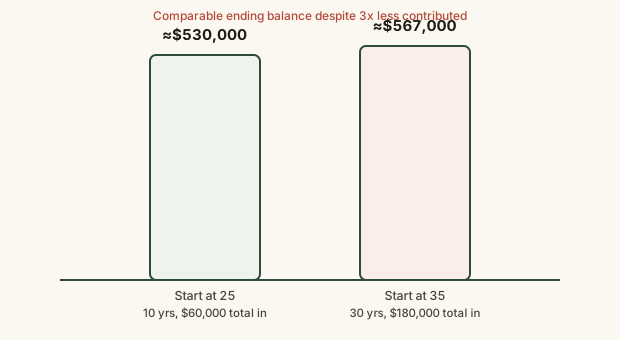
The visual gap between total dollars contributed and total ending balance is the entire mechanism — the early starter's advantage comes exclusively from time spent invested, not from contributing more money or picking better investments.
Common mistakes
Common Mistakes
Treating a retirement account itself as "the investment," without realizing you still have to choose what to hold inside it.
→ An empty retirement account earns nothing — the tax treatment only applies to whatever investments you actively select and hold inside the account.
Contributing less than the amount needed to capture a full available employer match.
→ Since the match is tied to your own contribution up to a set percentage, contributing below that threshold means forfeiting employer money you were otherwise eligible for.
Assuming the tax treatment of a retirement account guarantees the investments inside it will grow or won't lose value.
→ Tax treatment affects what happens to the money you owe in taxes — it has no effect on market performance, which depends entirely on what's actually invested inside the account.
Common misconception
“Retirement accounts are a completely different, safer kind of investment than a regular brokerage account.”
A retirement account is a tax wrapper around ordinary investments, not a separate or inherently safer investment category. The same index fund held inside a retirement account and held in a regular taxable account carries identical market risk — the only difference is how and when the growth is taxed.
Try it yourself
Estimate how a starting amount could grow over time at a given average annual return, before accounting for any taxes, fees, or additional contributions.
This is a simplified mechanics illustration, not a projection of any real account's actual future performance, and does not account for taxes, fees, or additional contributions. Actual investment returns vary and are never guaranteed.
What to do next
What to do next
- Check whether your employer offers a retirement account match, and confirm the exact contribution percentage needed to capture the full match.
- Review official IRS guidance on the specific tax treatment and contribution limits of any retirement account before contributing.
- Confirm what investments are actually held inside your retirement account — the account type doesn't select investments for you.
- If you're unsure which account structure fits your situation, consult a qualified tax professional rather than relying on generic rules of thumb, since the right answer depends on your individual tax circumstances.