 KnowThis
Key Takeaways
Key Takeaways
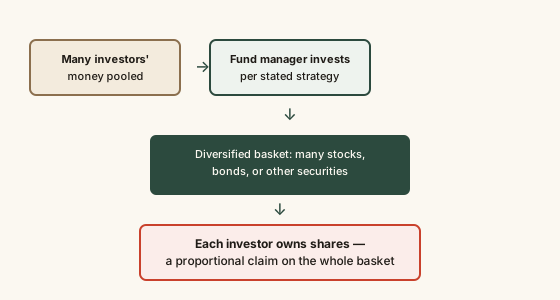
- 1A mutual fund pools money from many investors into one professionally managed portfolio holding many different securities at once.
- 2Each investor owns shares of the fund itself, not the underlying stocks or bonds directly — returns track the whole pooled portfolio's performance.
- 3Per SEC and FINRA guidance, a fund's expense ratio and stated investment strategy are two of the most important things to check before investing, since fees compound over time just as returns do.
Mutual funds at a glance
| Feature | Mutual fund | Single stock |
|---|---|---|
| What you own | A slice of a whole basket of holdings | Part of one company |
| Pricing | Once a day, at NAV | All day, at the market price |
| Ongoing cost | Expense ratio, taken from fund assets every year | No yearly fund fee (trading costs may apply) |
| Possible sales charge | Front-end or back-end load on some funds | Broker commission, if any |
| Single-company risk | Spread thin across holdings | All of it |
The concept
This once-a-day pricing is a structural feature, not a limitation — since a mutual fund's value is based on all its underlying holdings, a single end-of-day calculation is enough to fairly price shares for anyone buying or selling that day.
An investor buys one share of a mutual fund that holds 200 different company stocks. One of those 200 companies has a very bad quarter. What is the most accurate description of the effect on the investor?
Worked examples
Example 1: Buying shares of a broad stock market fund (baseline case)
Example 2: Comparing two funds with different expense ratios (edge case / variation)
Example 3: Redeeming shares during a market downturn (real-world / applied case)
Two mutual funds have nearly identical holdings and historical returns, but one has a much higher expense ratio. According to FINRA guidance, why does this difference matter?
How it works (visual)
Common mistakes
Common Mistakes
Assuming buying a mutual fund share means owning a specific stock directly.
→ Understand you own a proportional claim on the fund's whole diversified pool of holdings, not any single underlying security.
Ignoring the expense ratio when comparing funds.
→ Check the expense ratio for any fund under consideration — per FINRA guidance, it directly and predictably reduces long-term net returns.
Believing diversification means a fund can't lose value.
→ Recognize diversification spreads risk across holdings; it doesn't eliminate market-wide declines affecting most or all of the fund's holdings at once.
Common misconception
“A mutual fund is basically the same thing as investing directly in one company's stock, just with more paperwork.”
A mutual fund share represents proportional ownership of a whole diversified basket of many different holdings, priced once per day via NAV, per SEC and FINRA descriptions. This is structurally different from owning a single company's stock, which trades continuously and depends entirely on that one company's performance. The pooled, diversified structure — and its ongoing expense ratio — are the two defining features that distinguish a mutual fund from a direct individual stock purchase.
What to do next
What to do next
- Before investing in any mutual fund, check its stated investment strategy and confirm it matches your actual goals and risk tolerance.
- Compare expense ratios across similar funds — per FINRA guidance, even small ongoing fee differences compound meaningfully over long periods.
- Understand that diversification reduces single-holding risk, not overall market risk — a fund can still lose value in a broad market downturn.
- This is general educational information, not personalized investment advice — consult a licensed financial professional for decisions specific to your situation.