 KnowThis
Key Takeaways
Key Takeaways
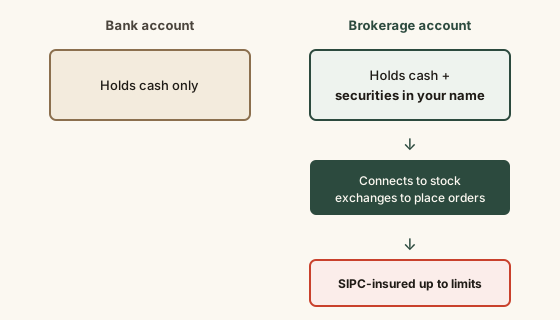
- 1A brokerage account holds cash plus securities registered in your name — a bank account only ever holds cash.
- 2A brokerage account connects to stock exchanges, letting you place actual buy and sell orders — a bank account can't do this.
- 3SIPC insurance protects brokerage holdings (within limits) if the brokerage firm itself fails financially — it does not protect against your investments simply losing value.
The concept
This distinction — SIPC covers firm failure, not market losses — is the single most commonly misunderstood point about brokerage accounts, and it's worth being precise about before opening one.
An investor's brokerage firm goes bankrupt. Separately, the stock they own drops 40% in value the same month. What does SIPC insurance cover?
Worked examples
Example 1: Opening a first brokerage account (baseline case)
Example 2: A brokerage account vs. a 401(k) (edge case / variation)
Example 3: A brokerage firm failure (real-world / applied case)
If a brokerage firm fails, what typically happens to a customer's actual stock holdings first, per SIPC's process?
How it works (visual)
Common mistakes
Common Mistakes
Assuming SIPC insurance protects against investment losses the same way FDIC protects bank deposits.
→ Understand SIPC covers brokerage-firm failure specifically, not market-driven losses in the value of what you own.
Leaving deposited cash sitting uninvested in a brokerage account indefinitely, assuming it's automatically invested.
→ Opening the account and buying securities are separate steps — cash sits uninvested until you place an order, sometimes earning minimal or no interest depending on the account's settings.
Choosing a brokerage based on ads alone without checking it's a real, SIPC-member firm.
→ Verify SIPC membership and the firm's regulatory standing before depositing money, using FINRA's public BrokerCheck tool.
Common misconception
“A brokerage account is basically just a bank account with a different name.”
The core function is genuinely different: a bank account holds and moves cash; a brokerage account holds cash and ownership stakes in actual securities, and connects directly to the exchanges where those securities trade. The insurance backing them is also structurally different — FDIC for banks, SIPC for brokerages — with SIPC explicitly excluding ordinary market losses.
What to do next
What to do next
- Before opening a brokerage account, verify the firm is a real SIPC member using FINRA's BrokerCheck tool.
- Understand clearly that SIPC insurance does not cover ordinary investment losses from market movement.
- Don't assume deposited cash is automatically invested — check whether it needs a separate buy order.
- This is general information, not personalized investment advice — for decisions specific to your financial situation, consult a licensed financial professional.