 KnowThis
Key Takeaways
Key Takeaways
- 1Opportunity cost in spending is the value of what you gave up by not saving or investing that money instead — it's a real number, not just a moral judgment about a purchase.
- 2Because of compounding, the opportunity cost of a purchase grows the longer that money would have otherwise been invested — a cost paid in your 20s is far larger by retirement than the same cost paid in your 50s.
- 3This is a framework for evaluating trade-offs, not an argument that spending is always wrong — opportunity cost applies to saving decisions too, since money sitting idle also has a cost.
The concept
Seeing the actual dollar figures a purchase's opportunity cost represents is what turns this from an abstract idea into something genuinely useful for decision-making.
Does opportunity cost mean that spending money is always a financial mistake?
Worked examples
Example 1: A single $500 purchase over a 30-year horizon (baseline case)
Example 2: The same purchase made 15 years later instead (edge case / variation)
Example 3: A recurring small expense, not a one-time purchase (real-world / applied case)
Why does a recurring $6/day expense have a larger opportunity cost than simply multiplying $6 by the number of days?
How it works (visual)
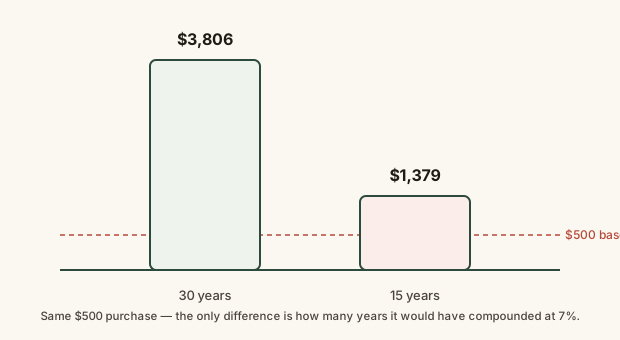
Both bars start from the identical $500 purchase — the difference in height is purely the effect of how many years that money would have had to compound before being needed, which is the entire mechanism behind why "spend less now" and "start investing early" are treated as closely related pieces of financial advice.
Common mistakes
Common Mistakes
Treating a purchase's opportunity cost as identical to its sticker price.
→ Remember the real opportunity cost is what that money could have grown to over the relevant time horizon, not the amount itself — the gap widens the longer the horizon.
Using opportunity cost as a reason to avoid all spending entirely.
→ Opportunity cost is one input for weighing a decision, not a rule against spending — money also has legitimate value used today, and the framework is about visibility, not verdicts.
Ignoring opportunity cost for recurring expenses because each individual instance looks small.
→ Multiply a recurring expense out over a real time horizon and apply the same compounding logic — small recurring costs often carry a larger cumulative opportunity cost than an occasional larger purchase.
Common misconception
“Opportunity cost only matters for big financial decisions like buying a car or a house.”
Opportunity cost applies at any spending scale, and recurring small expenses often carry a larger cumulative opportunity cost than an occasional big purchase, precisely because each instance compounds on its own timeline. The size of the individual purchase matters less than the size and frequency of the money involved and the time horizon it would have otherwise had to grow.
Try it yourself
What to do next
What to do next
- For a genuinely large or recurring purchase decision, run the numbers through a compound-growth calculator using your actual likely time horizon, not just the sticker price.
- Remember time horizon matters more than the dollar amount for how large an opportunity cost grows — the same spending decision made 10 years earlier has a meaningfully larger opportunity cost.
- Use this framework for comparison, not guilt — the goal is an informed trade-off, not eliminating all spending.
- Apply the same lens to idle savings sitting in a low-yield account — that money has an opportunity cost too, relative to a higher-yield alternative.