 KnowThis
Key Takeaways
Key Takeaways
- 1Lifestyle inflation is spending rising in step with income — a raise or promotion that quietly gets absorbed into higher recurring costs instead of a higher savings rate.
- 2It happens mostly through fixed, recurring costs (a bigger apartment, a nicer car payment, more subscriptions) rather than one-time splurges, which is why it's easy to miss month to month.
- 3The core measurable effect is a flat or shrinking savings rate despite a rising income — someone earning double their previous salary but saving the same dollar amount has a lower savings rate than before, not a higher one.
The concept
The clearest way to see the effect is to compare two people with very different incomes but the same savings rate outcome.
Someone's income doubles from $50,000 to $100,000 a year, and the dollar amount they save each year also stays exactly the same. What happened to their savings rate?
Worked examples
Example 1: A raise fully absorbed into a bigger apartment (baseline case)
Example 2: The same raise split between spending and savings (edge case / variation)
Example 3: Comparing two earners with very different incomes but the same savings rate (real-world / applied case)
Why can a person earning $150,000 a year end up saving less in dollar terms than someone earning $45,000 a year?
How it works (visual)
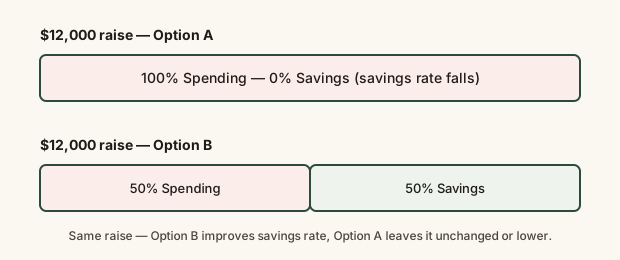
The raise amount is identical in both bars — the only difference is how it gets allocated between new spending and new savings, which is the entire mechanism behind whether a raise improves, maintains, or erodes an overall savings rate.
Common mistakes
Common Mistakes
Assuming a higher income automatically means better savings outcomes.
→ Track savings rate (savings ÷ income), not just savings amount or income level — a high income with a low rate can underperform a modest income with a strong rate.
Letting a raise get allocated to new recurring fixed costs by default, without a deliberate savings decision.
→ When income rises, deliberately split the increase between spending and savings before new recurring costs (rent, car payment, subscriptions) lock in a higher permanent baseline.
Treating any spending increase after a raise as automatically "lifestyle inflation" in a negative sense.
→ The issue isn't spending more after a raise — it's spending 100% of a raise with no corresponding increase in savings rate. A deliberate, partial increase in both spending and savings isn't the problem this concept describes.
Common misconception
“Lifestyle inflation means any increase in spending after a raise is a financial mistake.”
The concept specifically describes a raise being fully absorbed into new recurring costs with no improvement in savings rate — a deliberate choice to increase both spending and savings from a raise isn't the same pattern, and isn't inherently a problem. The relevant metric is what happens to savings rate, not whether spending changed at all.
What to do next
What to do next
- Calculate your current savings rate (annual savings ÷ annual income) as a baseline before your next raise.
- When a raise arrives, decide deliberately what share goes to increased savings before committing to any new recurring cost.
- Watch for new recurring fixed costs specifically (rent, car payments, subscriptions) — these are where lifestyle inflation compounds the most, since they persist every month rather than being one-time.
- Recheck your savings rate periodically, not just your savings account balance — a rising balance can still reflect a shrinking rate if income has grown faster than savings.