 KnowThis
Key Takeaways
Key Takeaways
- 1A budget is a plan that matches income against expenses over the same period, so a surplus or shortfall is visible in advance rather than discovered after the fact.
- 2The core equation is: income minus expenses equals cash flow — a positive number means money left over, a negative number means spending exceeded what came in.
- 3Budgeting isn't about restriction for its own sake; it's a forecasting tool that turns 'I think I'm doing okay financially' into an actual, checkable number.
The concept
Understanding the mechanics is the easy part; the actual skill is in building an expense list that's honest and complete, not just the categories that come to mind first.
Someone builds a budget listing their rent, groceries, and phone bill, but leaves out their twice-yearly car insurance premium since it 'isn't a monthly expense.' What's the problem with this approach?
Worked examples
Example 1: A simple monthly budget with a surplus (baseline case)
Example 2: Folding an irregular expense into the monthly average (edge case / variation)
Why divide an irregular expense (like a twice-yearly premium) by the number of months between payments, rather than just budgeting for it the month it's actually due?
Example 3: A budget that reveals a shortfall before it happens (real-world / applied case)
How it works (visual)
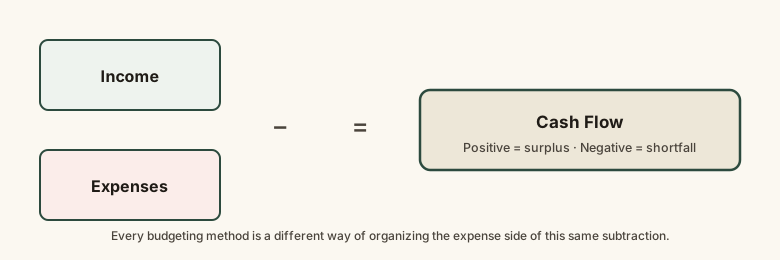
Every budgeting method covered elsewhere in this cluster — the 50/30/20 rule, zero-based budgeting, envelope systems — is really just a different way of organizing the expense side of this same subtraction; the underlying arithmetic never changes.
Common mistakes
Common Mistakes
Leaving out irregular or annual expenses because they don't recur every month.
→ Divide irregular expenses by the number of months between payments and budget that average amount monthly.
Using an optimistic income figure instead of realistic take-home pay, especially for variable or commission-based income.
→ Use actual historical take-home pay (after taxes and deductions), and for variable income, use a conservative recent average rather than a best month.
Building a budget once and never comparing it against what actually happened.
→ Check actual spending against the budgeted plan periodically — a budget that's never compared to reality can't catch categories that were consistently underestimated.
Common misconception
“A budget is a restriction — a list of things you're not allowed to spend money on.”
A budget is a forecasting tool, not a set of rules. It simply states, in advance, what will happen to a given amount of income if a given set of expenses occurs — the same way a weather forecast doesn't control the weather, a budget doesn't control spending by itself. What a person does with the forecast (adjust a category, accept a shortfall, save a surplus) is a separate decision from the arithmetic of building the budget itself.
What to do next
What to do next
- List every income source using realistic, after-tax take-home figures, not gross pay or best-case estimates.
- List every expense category, including irregular ones like annual premiums or car maintenance, averaged into a monthly figure.
- Subtract total expenses from total income to see the actual cash flow number before the month happens, not after.
- Revisit the budget against real spending periodically — categories that are consistently wrong are worth correcting rather than ignoring.