 KnowThis
Key Takeaways
Key Takeaways
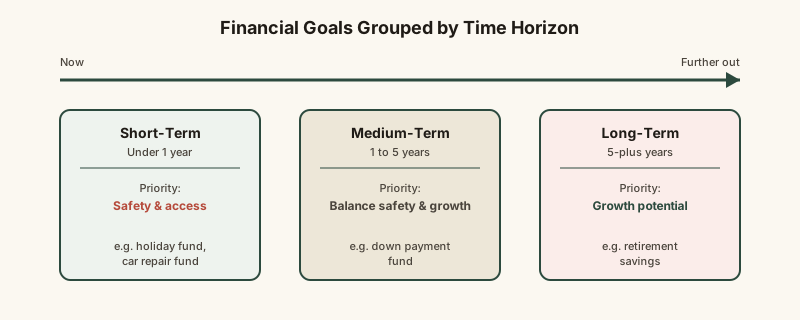
- 1Financial goals are grouped by time horizon — short-term (under a year), medium-term (one to five years), and long-term (five-plus years) — because the horizon determines the appropriate way to hold the money.
- 2A specific, dated goal ("$3,000 for a car repair fund by next June") is more actionable than a vague one ("save more money") because it defines exactly how much needs to be set aside and by when.
- 3Mismatching a goal's time horizon with how the money is held — for example, investing a short-term goal's funds in a volatile asset — creates the risk of the money losing value right when it's needed.
The concept
The time-horizon grouping mainly exists to guide one practical decision: where the money for a given goal should sit while it accumulates.
Someone is saving for a house down payment they expect to make in 18 months. Which time-horizon bucket does this goal fall into, and what does that suggest about where to hold the funds?
Worked examples
Example 1: A short-term goal with a clear monthly savings target (baseline case)
Example 2: Multiple goals with different horizons competing for the same budget (edge case / variation)
Example 3: A goal's time horizon shortening as the deadline approaches (real-world / applied case)
How it works (visual)
Common mistakes
Common Mistakes
Setting a vague goal ("save more this year") with no specific target amount or date.
→ Define every goal with a specific dollar amount and target date, so it can be broken into a concrete monthly savings figure.
Holding short-term goal funds in a volatile, growth-oriented vehicle where a downturn right before the deadline could shrink the available amount.
→ Match each goal's time horizon to an appropriately safe and accessible place to hold the funds — the shorter the horizon, the more that safety and accessibility should be prioritized over growth potential.
Waiting to start a long-term goal until all short-term goals are fully funded first.
→ Contribute to short-, medium-, and long-term goals in parallel where possible, since long-term goals benefit disproportionately from starting earlier.
Common misconception
“Only large goals like retirement count as real financial goals — small short-term savings targets don't need the same structure.”
The same specificity (a target amount and a target date) that makes a long-term goal actionable applies just as much to a small short-term one. A $300 goal for a specific purchase in two months benefits from the same clear monthly target-setting as a $300,000 retirement goal — the size of the goal doesn't change the value of defining it clearly.
Try it yourself
What to do next
What to do next
- Write down each financial goal with a specific dollar amount and target date.
- Sort goals into short-term (under 1 year), medium-term (1-5 years), and long-term (5-plus years) buckets.
- For each goal, divide the target amount by the number of months remaining to get a monthly savings target.
- Match where each goal's funds are held to its time horizon, favoring safety and accessibility for shorter horizons.