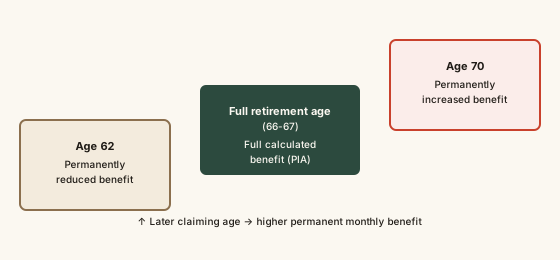
Social Security retirement benefits are calculated from a worker's highest 35 years of earnings, adjusted into an average monthly figure that determines the benefit paid at full retirement age — per the Social Security Administration, a worker can claim as early as age 62 for a permanently reduced monthly benefit, wait until their full retirement age (66-67, depending on birth year) for their full calculated benefit, or delay up to age 70 for permanently increased monthly payments, with each year of early or delayed claiming changing the monthly amount for the rest of the recipient's life, not just temporarily.
Reading time
— 4 min
Updated
— Oct 10, 2026
Fact-reviewed
— Oct 10, 2026
Key Takeaways
Key Takeaways
1Social Security is calculated from a worker's highest 35 years of earnings, producing a full benefit amount payable at full retirement age.
2Claiming as early as 62 permanently reduces the monthly benefit; delaying past full retirement age up to 70 permanently increases it.
3The claiming-age decision changes the monthly amount for the rest of the recipient's life, not just for a temporary period.
Social Security claiming ages at a glance
Short answer: Social Security pays a monthly retirement benefit based on your highest 35 years of earnings. You can start at 62, but the check is permanently smaller: about 30% smaller if your full retirement age is 67. Wait until full retirement age (67 for anyone born in 1960 or later) and you get 100% of your calculated benefit. Every year you wait after that, up to 70, adds 8%. To qualify at all, you generally need 40 work credits, which is about 10 years of work.
Claim at (full retirement age 67)
Monthly benefit vs. your full amount
62
About 70% (permanently reduced)
67
100% (your Primary Insurance Amount)
70
About 124% (three years of 8% delayed credits)
Percentages follow the SSA's published reduction and delayed-credit rules. Your own dollar figures are on your earnings record at ssa.gov.
The concept
Social Security looks at your highest-earning 35 working years to figure out a base monthly benefit amount. You can start collecting as early as 62, but the check will be permanently smaller than if you had waited. Wait until your full retirement age (66 or 67 for most people today) and you get the full calculated amount. Wait even longer, up to 70, and the monthly amount keeps growing. Whatever age you pick, that adjustment sticks for the rest of your life — it isn't a temporary early-bird discount that goes away later.
This permanence is also why the decision is worth getting right the first time — per SSA guidance, once monthly payments begin, the claiming-age adjustment generally cannot be undone except through a narrow, limited window shortly after the initial claim.
Quick check
A worker claims Social Security at age 62 instead of waiting until their full retirement age of 67. What happens to their monthly benefit amount over time?
Worked examples
Example 1: Claiming exactly at full retirement age (baseline case)
A worker with a full retirement age of 67 claims Social Security exactly at 67 and receives their full calculated Primary Insurance Amount, with no reduction or increase applied.
Example 2: Claiming early due to a health situation (edge case / variation)
A worker in poor health with a shorter expected lifespan claims at 62 despite the permanent reduction, reasoning that receiving a smaller monthly amount over more expected years may provide more total lifetime benefit than a larger amount over fewer years — a real, individual trade-off the SSA acknowledges depends on personal circumstances.
Example 3: Delaying to age 70 for maximum monthly benefit (real-world / applied case)
A worker with other income sources and good health delays claiming until age 70, earning delayed retirement credits each year past full retirement age — per SSA guidance, this produces the highest possible monthly benefit available to that worker, locked in for life once claimed.
Quick check
Per SSA guidance, why might delaying a Social Security claim past full retirement age make sense for some workers but not others?
How it works (visual)
How claiming age changes the monthly benefit, permanently
Common mistakes
Common Mistakes
✕
Assuming a reduced early-claiming benefit later corrects itself to the full amount.
→ Understand the reduction (or increase from delaying) is permanent for the life of the benefit, per SSA guidance.
✕
Treating the claiming-age decision as easily reversible.
→ Recognize this is one of the most consequential retirement decisions and review your individual earnings record with the SSA before deciding.
✕
Assuming there's a single 'correct' claiming age for everyone.
→ Weigh your own health, other income sources, and any spousal benefit considerations, since the SSA notes the right choice varies by individual circumstances.
Common misconception
“Claiming Social Security early just means getting a smaller check for a few years until it catches up to the full amount later.”
Per SSA guidance, the reduction from early claiming — or the increase from delayed claiming — is a permanent adjustment to the monthly benefit for the rest of the recipient's life. It doesn't reset or catch up automatically once the recipient reaches full retirement age or any other milestone. This permanence is exactly why the SSA frames the claiming-age decision as one of the most consequential choices in retirement planning, not a minor timing detail.
What to do next
What to do next
Check your own Primary Insurance Amount and full retirement age using your actual SSA earnings record, not a generic estimate.
Weigh health, other income sources, and any spousal benefit considerations before deciding when to claim.
Understand that claiming before full retirement age permanently reduces your monthly benefit, and delaying past it permanently increases it.
This is general educational information, not personalized financial advice — consult the SSA directly or a licensed financial professional for decisions specific to your situation.
FAQ
FAQ
Related terms
Related terms
Full retirement age (FRA)
The age at which a worker is entitled to their full calculated Social Security benefit, set by the Social Security Administration based on birth year — currently 66 to 67 for most workers.
Primary Insurance Amount (PIA)
The monthly benefit amount a worker would receive if they claim Social Security exactly at their full retirement age, calculated from their highest 35 years of earnings.
Delayed retirement credit
A permanent increase to a worker's monthly Social Security benefit for each year they delay claiming past full retirement age, up to age 70.
This entry was researched from public sources and drafted with AI-assisted tools, then edited — errors are still possible. Spot one, or want a topic covered? Read our disclaimer.
 KnowThis