 KnowThis
Key Takeaways
Key Takeaways
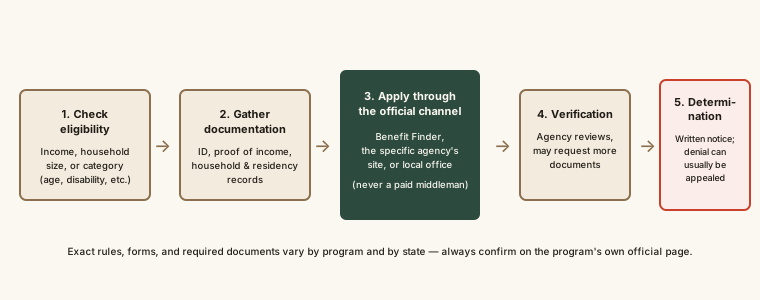
- 1Most government assistance programs determine eligibility from income and household size, or from belonging to a defined category, or some combination of both.
- 2Nearly every program requires documentation — identity, income, household composition, and residency — before an application can be verified.
- 3USA.gov's Benefit Finder (the successor to Benefits.gov) is the real federal tool for locating the specific programs a person may qualify for, but the final word on any individual case always comes from that program's own official page.
The concept
The reason this shared structure is worth understanding is practical: once you recognize that most programs are asking the same underlying questions — who's in your household, what do you earn, do you belong to a qualifying category, and can you document it — gathering what you need for one application makes the next one considerably faster.
A program's eligibility page says an applicant may qualify either by meeting an income and household-size limit, or by already receiving a specific other benefit. What does this second route represent?
Worked examples
Example 1: Checking eligibility before applying (baseline case)
Example 2: Qualifying through a category instead of income alone (edge case / variation)
Example 3: Applying for housing assistance through a local agency (real-world / applied case)
An applicant is told they're eligible for a housing assistance program but placed on a waiting list rather than receiving assistance right away. What does this generally indicate?
How it works (visual)
Common mistakes
Common Mistakes
Assuming one program's income limit or document list applies to a different program.
→ Check the specific program's own official government page — thresholds, categories, and required documents vary by program and by state.
Paying a third party to 'help' apply for or guarantee approval of a benefit.
→ Apply directly through the official government channel — USA.gov's Benefit Finder, the specific agency's site, or a local office. Legitimate government assistance programs don't require payment to apply.
Assuming a denial is final with no further options.
→ Read the determination notice carefully — most programs include an appeal process, and a denial can sometimes be reversed with additional documentation or by correcting an error.
Common misconception
“If your income is above a program's general limit, you automatically don't qualify for any assistance.”
Per USDA and HUD guidance, many programs offer more than one path to eligibility — an income-and-household-size test is common, but categorical eligibility (qualifying by belonging to a defined group, such as already receiving a related benefit, being over a certain age, or having a qualifying disability) can apply even where a general income limit alone would not have been met. The only reliable way to know whether a specific situation qualifies is to check that program's own official government page or use a tool like USA.gov's Benefit Finder — this article explains the general mechanism, not a determination for any individual case.
What to do next
What to do next
- Use USA.gov's Benefit Finder to get an initial list of programs you may be eligible for based on your actual situation.
- Gather core documentation ahead of time: proof of identity, proof of income, household composition, and residency records.
- Apply only through the program's own official government page or a local government office — never a paid third party claiming to guarantee approval.
- This is general educational information, not a guarantee of eligibility for any specific program — confirm the current rules and required documents on that program's own official page before applying.