What Disability Benefits Actually Require to Qualify
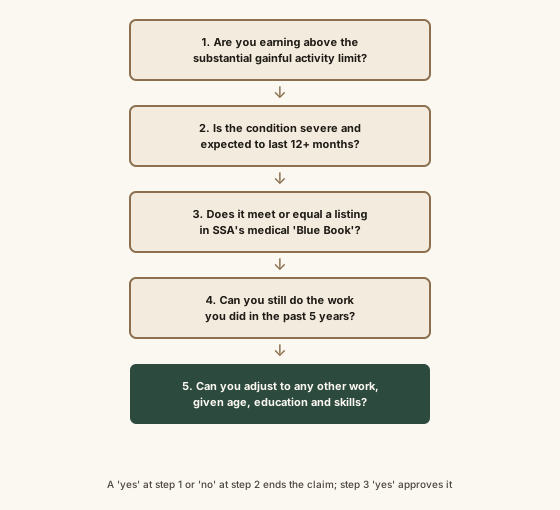
To qualify for U.S. Social Security disability benefits, you must have a medically determinable physical or mental impairment that is expected to last at least 12 months or result in death, and that prevents you from doing substantial gainful activity (SGA). In 2026, SGA means earning more than $1,690 a month ($2,830 if you're blind). The Social Security Administration (SSA) decides using a five-step process: whether you're working above SGA, whether the condition is severe, whether it meets a listing in SSA's medical 'Blue Book', whether you can do your past relevant work, and whether you can adjust to any other work given your age, education and experience. There are two programs. Social Security Disability Insurance (SSDI) is based on your work record and generally requires 40 work credits with 20 earned in the last 10 years (fewer if you're younger); it has a five-month waiting period, and Medicare starts after 24 months of entitlement. Supplemental Security Income (SSI) is needs-based, with a 2026 federal payment of up to $994 a month for an individual and a $2,000 resource limit. Many initial claims are denied, and you have 60 days to appeal each decision.
Reading time
— 5 min
Updated
— Sep 27, 2026
Fact-reviewed
— Sep 27, 2026
Key Takeaways
Key Takeaways
1U.S. Social Security disability needs a medical condition expected to last 12+ months that stops you from earning above a monthly limit ($1,690 in 2026).
2The test is whether you can do any substantial work given your age, education and skills, not just your old job.
3SSDI is based on your work record; SSI is based on low income and assets. Many first claims are denied, and appeals often succeed.
The concept
Social Security's definition of disability is strict. It's not about whether you have a diagnosis, or even whether you can do the job you had. It asks: does a medical condition that will last at least a year stop you from doing any work that pays more than a set monthly amount? In 2026 that amount is $1,690 a month. There are two programs. SSDI is like insurance you paid into through payroll taxes, so it needs a work history. SSI is for people with very little income and savings, whether or not they've worked. You can sometimes get both. The key to either one is medical evidence showing what you can and can't do day to day.
Quick check
Which question does SSA ask at step 5?
Worked examples
Example 1: A worker with a long record (baseline case)
Dana, 56, worked 30 years as a warehouse supervisor and has severe spinal stenosis that her surgeon expects to be permanent. She stopped working in January. She has far more than 40 work credits, including 20 in the last 10 years, so she's insured for SSDI. She isn't working (step 1), the condition is severe and long-lasting (step 2), and it may not meet a listing exactly (step 3). Her RFC limits her to sedentary work, so she can't return to warehouse work (step 4). At 56, with no transferable desk-job skills, SSA's age rules make it likely she's found disabled at step 5. If approved, SSDI starts after five full months, and Medicare 24 months after that.
Example 2: Working part-time while applying (edge case)
Luis, 34, has multiple sclerosis with severe fatigue and works 15 hours a week, earning $1,100 a month. That's below the 2026 SGA limit of $1,690, so step 1 doesn't automatically end his claim. SSA will still look closely at his work: whether he needs special accommodations, extra breaks or a sympathetic employer. If he picks up extra shifts and earns $1,800 a month, he'd be above SGA and generally found not disabled for those months. Being close to the line is legal, but earnings need careful tracking and reporting.
Example 3: Denied, then appealing (real-world use)
Aisha's initial claim for SSI is denied. The notice says her records don't show enough limitation. She has 60 days (plus 5 days assumed for mail) to request reconsideration. She asks her doctor for a detailed statement of her functional limits, not just her diagnosis (how long she can sit, stand, lift and concentrate), and adds treatment records from a specialist she saw after applying. If reconsideration is denied, the next levels are a hearing before an administrative law judge, the Appeals Council, and federal court. Many people who are ultimately approved win at the hearing stage, which is why not giving up after the first denial matters.
Quick check
Why didn't Luis's part-time work automatically end his claim?
How it works (visual)
SSA's five-step disability evaluation
Common mistakes
Common Mistakes
✕
Relying on a diagnosis instead of evidence of limitations.
→ Ask treating doctors to document specific functional limits (sitting, standing, lifting, concentration, attendance).
✕
Missing the 60-day appeal deadline and starting over.
→ Appeal in time; a new application can lose months of potential back pay.
✕
Gaps in treatment.
→ Keep seeing providers and follow prescribed treatment when you can; SSA relies heavily on medical records.
Common misconception
“If my doctor says I can't work, Social Security has to approve me.”
SSA makes its own decision using the five-step process. A doctor's opinion is important evidence, especially when it describes specific limitations and is backed by records, but it isn't binding. SSA also weighs whether you could do other, less demanding work. That's why detailed functional evidence usually matters more than a note that simply says "unable to work." Veterans with service-connected conditions have a separate system with its own percentage ratings; see what veterans benefits actually include.
What to do next
What to do next
Check your work credits in your my Social Security account at ssa.gov.
Gather medical records, test results and a list of every provider you've seen for the condition.
Ask your doctor for a statement describing your specific functional limits.
If denied, mark the 60-day appeal deadline and consider a disability attorney or advocate (fees are capped and usually paid only if you win).
FAQ
FAQ
Related terms
Related terms
SSDI
Social Security Disability Insurance: benefits for disabled workers who paid enough Social Security taxes, based on their earnings record.
SSI
Supplemental Security Income: a needs-based federal payment for disabled, blind or older people with very limited income and assets.
Substantial gainful activity (SGA)
Work earning above a monthly limit set each year ($1,690 in 2026 for non-blind applicants); earning above it generally means SSA won't find you disabled.
Blue Book
SSA's list of medical impairments and criteria that, if met, qualify as disabling at step 3.
Residual functional capacity (RFC)
SSA's assessment of the most you can still do physically and mentally despite your condition, used at steps 4 and 5.
This entry was researched from public sources and drafted with AI-assisted tools, then edited — errors are still possible. Spot one, or want a topic covered? Read our disclaimer.
 KnowThis