How Public Health Insurance Programs Actually Work
The U.S. has three main public health insurance programs. Medicare, run by the federal government, covers people 65 and older, people under 65 who have received Social Security disability benefits for 24 months, and people with end-stage renal disease or ALS, per Medicare.gov and the Social Security Administration. It has parts: Part A (hospital, usually premium-free after about 10 years of Medicare-taxed work), Part B (doctor and outpatient care, with a monthly premium), Part C (Medicare Advantage plans from private insurers), and Part D (prescription drugs). Medicaid is jointly funded by the federal government and states and run by each state under federal rules, covering people with limited income and resources; states that adopted the Affordable Care Act expansion cover most adults up to 138% of the federal poverty level. CHIP covers children in families that earn too much for Medicaid but can't afford private coverage. People who qualify for both Medicare and Medicaid are called dual eligibles. Medicaid and CHIP applications are accepted year-round, while Medicare has set enrollment periods and late penalties.
Reading time
— 4 min
Updated
— Sep 26, 2026
Fact-reviewed
— Sep 26, 2026
Key Takeaways
Key Takeaways
1Medicare is federal and based mostly on age (65+) or disability. Medicaid and CHIP are based on income and run by each state.
2Medicare isn't free: most people pay a monthly premium for Part B, plus deductibles and coinsurance.
3Medicare has fixed sign-up windows and late penalties. Medicaid and CHIP accept applications any time of year.
The concept
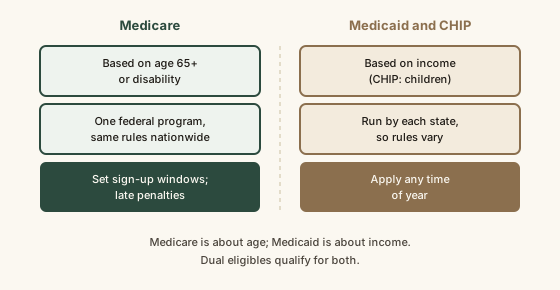
The easiest way to keep these straight: Medicare is about age, Medicaid is about income. Medicare is a national program you pay into through paycheck taxes over your working life, and it covers you when you turn 65 or if you become seriously disabled. It's the same across the country. Medicaid is for people with low income, and each state runs its own version, so who qualifies depends on where you live. CHIP is Medicaid's partner for kids: it covers children whose parents earn a bit too much for Medicaid but not enough to buy private insurance easily. And some people, often older adults with low income, qualify for both Medicare and Medicaid at once.
A 40-year-old with low income and no disability wants public coverage. Which program is most likely to apply?
Worked examples
Example 1: Turning 65 (baseline case)
A woman turns 65 in July after 30 years of work. Her Initial Enrollment Period runs from April through October. She signs up in May. Part A is premium-free because she paid Medicare taxes for far more than 10 years. Part B has a monthly premium, deducted from her Social Security check. She then chooses between Original Medicare plus a Part D drug plan (often with a supplemental policy) or a Medicare Advantage plan. Signing up on time means no late penalty.
Example 2: A family split across programs (the income edge)
A married couple with two children earns just over their state's Medicaid limit for adults. The parents don't qualify for Medicaid, but the children qualify for CHIP, because the state's CHIP income limit for children is higher. The parents look at subsidized Marketplace coverage on HealthCare.gov instead. One household, three different sources of coverage, all driven by where their income falls relative to each program's limit.
Example 3: Disability and dual eligibility (real-world use)
A 52-year-old man stops working after a serious illness and is approved for Social Security disability benefits. His Medicare coverage starts after 24 months of those benefits. His income is low, so he also qualifies for his state's Medicaid. Once Medicare starts, it pays first, and Medicaid helps cover his Part B premium and the costs Medicare doesn't. Knowing the 24-month rule lets him plan for coverage during the gap, which Medicaid can fill if he's eligible.
Quick check
In Example 2, why do the children have coverage when the parents don't?
How it works (visual)
Medicare vs. Medicaid and CHIP
Common mistakes
Common Mistakes
✕
Missing the Medicare sign-up window around age 65.
→ Mark the 7-month Initial Enrollment Period. If you have employer coverage, check whether it lets you delay Part B without a penalty.
✕
Assuming Medicaid rules are the same everywhere.
→ Check your own state's Medicaid agency. Income limits and covered services differ by state.
✕
Not applying because you think you earn too much.
→ Check anyway. Children often qualify for CHIP at incomes where adults don't, and expansion states have higher adult limits.
Common misconception
“Medicare and Medicaid are basically the same free government healthcare.”
They're different programs with different rules. Medicare is based on age or disability and is the same nationwide, but it isn't free: most people pay a monthly Part B premium, plus deductibles and usually 20% coinsurance on Part B services. Medicaid is based on income, run by each state, and usually has little or no cost to enrollees. Someone can qualify for one, both, or neither. Many veterans can also use VA health care, a separate system covered in what veterans benefits actually include.
What to do next
What to do next
If you're nearing 65, find your Initial Enrollment Period dates and whether any current coverage affects Part B timing.
If your income is low or has dropped, check your state's Medicaid limits through HealthCare.gov or your state agency. You can apply any time.
If you have children, check CHIP limits separately from adult Medicaid limits.
Keep proof of income and household size ready; applications ask for both.
For personal guidance, contact your State Health Insurance Assistance Program (SHIP) for free Medicare counseling.
FAQ
FAQ
Related terms
Related terms
Medicare
The federal health insurance program for people 65 and older, certain younger people with disabilities, and people with end-stage renal disease or ALS.
Medicaid
A joint federal-state health coverage program for people with limited income and resources, run by each state within federal rules.
CHIP
The Children's Health Insurance Program, covering uninsured children in families whose income is too high for Medicaid but too low to afford private coverage.
Initial Enrollment Period
The 7-month window around your 65th birthday (3 months before, your birthday month, and 3 months after) when you can first sign up for Medicare.
Dual eligible
Someone who qualifies for both Medicare and Medicaid. Medicaid can then help with Medicare premiums and costs.
This entry was researched from public sources and drafted with AI-assisted tools, then edited — errors are still possible. Spot one, or want a topic covered? Read our disclaimer.
 KnowThis