Health Insurance Basics: Premiums, Deductibles, Copays
Health insurance cost-sharing runs through a defined sequence: a premium keeps the plan active regardless of use, a deductible is the amount paid out of pocket before the plan starts sharing costs, coinsurance splits costs by percentage after the deductible, and a copay is a fixed fee for a specific service — all bounded by an annual out-of-pocket maximum after which the plan covers 100%.
Reading time
— 4 min
Updated
— Aug 22, 2026
Fact-reviewed
— Aug 22, 2026
This entry explains general health insurance terminology and mechanics — it is financial literacy, not personalized insurance or medical advice. Plan selection and coverage questions belong with a licensed insurance agent or your plan's official documents.
Key Takeaways
Key Takeaways
1A health plan's premium, deductible, copay, and coinsurance are four connected pieces of one cost-sharing sequence, not separate unrelated fees.
2The deductible has to be met first (with some exceptions like preventive care) before coinsurance-based cost-sharing on most other services begins.
3An out-of-pocket maximum caps total annual spending — once reached, the plan pays 100% of covered costs for the rest of the plan year, protecting against unlimited exposure.
The concept
A premium is what you pay to keep a health plan active, whether or not you use any care that month. A deductible is an amount you pay out of your own pocket for care before the plan starts helping pay. A copay is a flat fee for a specific visit or service, like $30 for a doctor visit. Coinsurance is a percentage split of a bill, like paying 20% while the plan pays 80%, that usually kicks in after the deductible is met.
Seeing how these pieces interact across a real medical bill makes the sequence concrete instead of abstract.
Quick check
A policyholder has a $1,500 deductible and hasn't used any care yet this plan year. They go to a specialist for a $400 covered service. How much do they typically pay?
Worked examples
Example 1: A single visit before the deductible is met (baseline case)
A policyholder with a $1,000 deductible visits an urgent care clinic for a $250 covered service, having paid nothing toward the deductible yet this year. Since the deductible isn't met, they typically pay the full $250 (at the plan's negotiated rate), which now counts toward their $1,000 deductible — leaving $750 still to go before coinsurance-based cost-sharing begins for most other services.
Example 2: A larger bill after the deductible is met, using coinsurance (edge case / variation)
The same policyholder later has a $5,000 procedure, and has already met their $1,000 deductible for the year. With 20% coinsurance, they pay 20% of the covered amount — $1,000 — while the plan pays the remaining $4,000. This is the point where deductible-based full-price payment shifts into percentage-based coinsurance sharing, exactly as the defined sequence describes.
Quick check
Why might the same $5,000 procedure cost a policyholder very different amounts depending on when in the plan year it happens?
Example 3: Reaching the out-of-pocket maximum (real-world / applied case)
Suppose a policyholder's plan has a $6,000 out-of-pocket maximum, and a major medical event over the year results in $6,000 in combined deductible, copay, and coinsurance payments by October. For the remainder of that plan year, the plan pays 100% of covered costs — no further deductible, copay, or coinsurance applies to covered services until the plan year resets. This cap is the specific mechanism that limits an individual's financial exposure to a single very expensive medical year, regardless of how large the total covered medical costs eventually became.
How it works (visual)
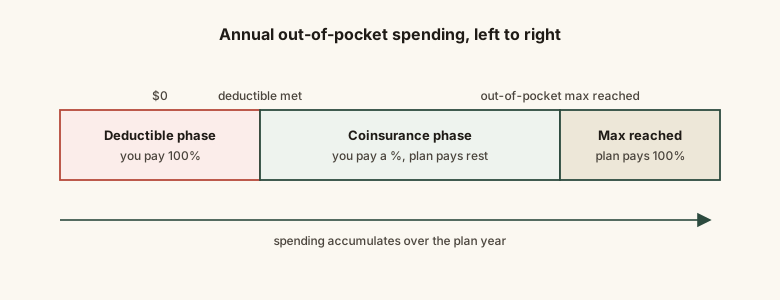
The cost-sharing sequence: deductible, then coinsurance, up to the out-of-pocket maximum
Reading left to right shows exactly how the policyholder's share of costs shrinks as their spending for the year accumulates — full price during the deductible phase, a percentage during coinsurance, and nothing once the annual cap is reached.
Common mistakes
Common Mistakes
✕
Assuming a copay applies to every kind of visit or service on a plan.
→ Check the plan's actual summary of benefits — many services use coinsurance instead of a flat copay, especially larger procedures, and this varies by plan design.
✕
Forgetting that most deductibles reset every plan year.
→ Track deductible progress across the calendar or plan year, since a procedure scheduled in December vs. January of the following year can mean paying a fresh deductible from zero.
✕
Confusing the premium with the total cost of using care.
→ Remember the premium keeps the plan active regardless of use — deductible, copay, and coinsurance are separate, additional costs tied specifically to the care actually received.
Common misconception
“A health plan with a lower premium is always the cheaper overall choice.”
A lower premium plan often carries a higher deductible or coinsurance percentage, shifting more cost onto the policyholder if they actually use care during the year. Someone who rarely uses medical care may come out ahead with a low-premium, high-deductible plan, while someone with predictable ongoing medical needs may pay less overall with a higher-premium, lower-deductible plan — the "cheaper" choice depends on expected usage, not the premium number alone.
What to do next
What to do next
Read a plan's summary of benefits to see exactly which services are copay-based versus coinsurance-based, and which (like many preventive services) may bypass the deductible entirely.
Track deductible and out-of-pocket maximum progress across the plan year, especially before scheduling a large elective procedure near a plan-year boundary.
Compare plans by estimated total annual cost (premium plus expected out-of-pocket spending), not premium alone.
Bring specific plan-selection and coverage questions to a licensed insurance agent or your HR benefits contact.
FAQ
FAQ
Related terms
Related terms
Deductible
The amount a policyholder must pay out of pocket for covered health services before the insurance plan begins sharing costs, resetting each plan year.
Copay
A fixed dollar amount a policyholder pays for a specific covered service, such as a doctor visit, regardless of the service's total cost.
Coinsurance
The percentage of a covered service's cost a policyholder pays after meeting the deductible, with the insurance plan paying the remaining percentage.
Out-of-pocket maximum
The most a policyholder has to pay for covered services in a plan year — once total out-of-pocket spending (deductible, copays, and coinsurance combined) reaches this limit, the plan pays 100% of covered costs for the rest of the year.
This entry was researched from public sources and drafted with AI-assisted tools, then edited — errors are still possible. Spot one, or want a topic covered? Read our disclaimer.
 KnowThis