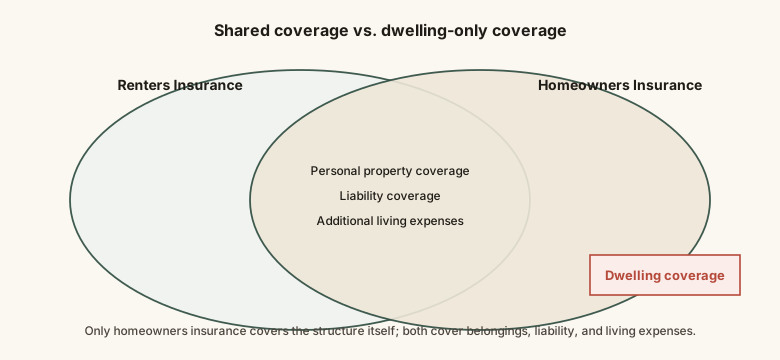
Homeowners insurance covers the physical structure of a home (dwelling coverage), the owner's personal belongings, personal liability for injuries or damage to others, and additional living expenses if the home becomes uninhabitable. Renters insurance covers the same personal property, liability, and additional living expenses categories, but not the structure itself, since a landlord's own policy typically covers the building.
Reading time
— 4 min
Updated
— Aug 22, 2026
Fact-reviewed
— Aug 22, 2026
This entry explains the general mechanics behind renters and homeowners insurance coverage types — it is financial literacy, not personalized insurance advice. Choosing specific coverage types and amounts belongs with a licensed insurance agent or broker who can assess your situation.
Key Takeaways
Key Takeaways
1Renters and homeowners insurance share three core building blocks: personal property coverage, liability coverage, and additional living expenses coverage.
2Homeowners insurance adds dwelling coverage for the physical structure itself — a category renters insurance doesn't need, since the landlord typically insures the building.
3A landlord's own insurance policy generally does not cover a tenant's personal belongings, which is exactly the gap renters insurance is designed to fill.
The concept
Both renters and homeowners insurance cover a person's belongings (personal property coverage), protect against being sued if someone gets hurt at the home (liability coverage), and help pay for a hotel if the home becomes unlivable (additional living expenses). The big difference is that homeowners insurance also covers the building itself, called dwelling coverage, while renters insurance doesn't need to, since the landlord's own policy usually covers the structure.
Looking at what happens in a few specific loss scenarios shows exactly which coverage applies to a renter versus an owner.
Quick check
A kitchen fire damages both the structure of a rented apartment and the tenant's furniture inside it. Whose insurance typically covers what?
Worked examples
Example 1: A burst pipe damages a homeowner's belongings and floors (baseline)
A homeowner's pipe bursts, damaging both the flooring (part of the structure) and a couch and rug (personal property). Dwelling coverage would typically apply to the flooring repair, and personal property coverage would typically apply to the couch and rug, both under the same homeowners policy — illustrating how one incident can trigger multiple sections of a single policy at once.
Example 2: The same burst pipe happens in a rented apartment (edge case / variation)
If the same burst pipe happens in a rented apartment, the flooring repair would typically fall to the landlord's own policy (since the tenant doesn't own the structure), while the tenant's damaged couch and rug would typically fall to the tenant's own renters insurance personal property coverage, if carried. A tenant without renters insurance would generally have no coverage at all for their own damaged belongings in this scenario, since the landlord's policy usually doesn't extend to a tenant's personal property.
Quick check
Why does a landlord's insurance policy generally not cover a tenant's personal belongings?
Example 3: A guest is injured at a rented apartment (real-world / applied)
A guest slips and is injured inside a tenant's rented apartment, resulting in a medical bill and a potential lawsuit against the tenant. If the tenant carries renters insurance with liability coverage, that coverage could potentially pay for the guest's medical costs and the tenant's legal defense costs, up to the policy's liability limit. Without renters insurance, the tenant could be personally responsible for those costs directly out of pocket — this is often the single most financially significant reason tenants are encouraged to carry renters insurance, even when their personal belongings alone wouldn't be worth much to insure.
How it works (visual)
Renters vs. homeowners insurance: shared coverage plus dwelling coverage
The shared middle region covers what both policy types have in common, while dwelling coverage sits only on the homeowners side, since it insures a structure only an owner has a financial stake in.
Common mistakes
Common Mistakes
✕
Assuming a landlord's insurance covers a tenant's personal belongings.
→ Recognize that landlord policies generally cover only the structure the landlord owns, not a tenant's separately owned property — renters insurance fills that specific gap.
✕
Underestimating the value of liability coverage in a renters policy because personal belongings alone don't seem worth insuring.
→ Consider liability coverage's role separately from personal property coverage — a guest injury lawsuit can be far more financially significant than the value of a tenant's belongings.
✕
Assuming a home's insured dwelling value automatically equals its market value.
→ Understand that dwelling coverage is typically based on rebuild cost, not market value, which include the land — these numbers can differ significantly.
Common misconception
“Renters insurance is unnecessary because renters don't own much of value.”
Renters insurance's liability coverage protects against injury lawsuits and legal defense costs that can far exceed the value of a tenant's belongings, and additional living expenses coverage can help pay for temporary housing if the rental becomes uninhabitable — both of these protections exist independently of how much personal property a tenant actually owns.
What to do next
What to do next
Check whether your lease requires renters insurance, and if not, weigh the liability and personal property protection against the typically low cost.
Review a homeowners policy's dwelling coverage amount against the estimated cost to rebuild the home, not its market value.
Ask what additional living expenses coverage would pay for and for how long, under either policy type.
Bring specific coverage-type and coverage-amount decisions to a licensed insurance agent or broker.
FAQ
FAQ
Related terms
Related terms
Dwelling coverage
The part of a homeowners insurance policy that pays to repair or rebuild the physical structure of a home if it's damaged by a covered peril.
Personal property coverage
Coverage that pays to repair or replace a policyholder's belongings, such as furniture and electronics, if damaged or stolen due to a covered peril — included in both renters and homeowners policies.
Liability coverage
Coverage that pays for injuries to other people or damage to their property that occurs on or is caused by the policyholder's property, plus legal defense costs if the policyholder is sued.
Additional living expenses
Coverage that pays for extra costs, such as a hotel stay and meals, if a covered event makes a home or rental temporarily uninhabitable.
This entry was researched from public sources and drafted with AI-assisted tools, then edited — errors are still possible. Spot one, or want a topic covered? Read our disclaimer.
 KnowThis